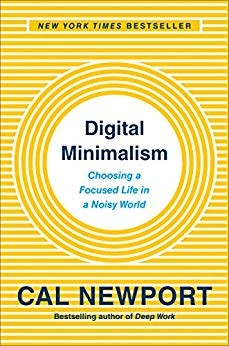
Talk to Digital Minimalism like its author wrote you back.
Get the ideas that fit your life — not generic summaries.
- Chat with the book
- Audiobook-style main ideas
- Adapts to your life and goals
- Helps you take action
Digital Minimalism, in detail
Digital Minimalism is Cal Newport's argument that most people's relationship with smartphones and social media is not freely chosen but engineered — the product of business models that monetize attention and design interfaces for compulsion rather than value. The solution Newport proposes is not moderation, which he argues is insufficient against attention-engineering at scale, but minimalism: a philosophy of using fewer digital tools, chosen deliberately, for clear purposes, with time otherwise reclaimed for higher-value activities.
Newport opens by documenting how the smartphone transformed from a communication device into an always-present attention-demand, pointing to the years 2007–2012 as the period when this shift became acute. He draws on psychological research to explain why social media is compelling — intermittent variable reward, social approval signals, the desire for social reciprocity — and argues that trying to use platforms moderately while these mechanisms are active is structurally similar to trying to gamble moderately in a casino designed to maximize gambling.
The book's practical centerpiece is the Digital Declutter: a thirty-day abstinence from all optional technologies, followed by a deliberate process of reintroduction where each tool must justify its reintroduction by providing specific value that outweighs its costs. This is not a temporary fast but the beginning of a permanent recalibration.
Newport then offers philosophical foundations for a post-declutter life: solitude as a practice (spending time alone with your own thoughts without consuming input), the value of doing leisure activities that require real-world skill, and the restoration of conversation as the primary form of social connection. Digital Minimalism is the most systematic treatment of the attention economy problem available for a general audience.
The big ideas
- 1.
Digital minimalism is a philosophy: you use fewer digital tools, chosen deliberately, that support your deeply held values. You don't moderate — you curate, and the standard for inclusion is high.
- 2.
Social media platforms are designed by professionals whose job is to maximize your time on platform. Moderation strategies are fighting against architectures optimized to overcome them.
- 3.
The Digital Declutter — thirty days without optional technology, followed by deliberate reintroduction — resets your relationship with these tools from compulsive to intentional.
