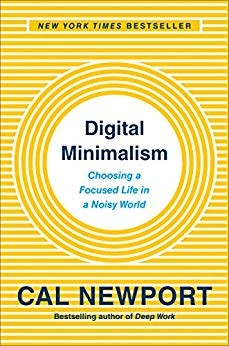
Digital Minimalism by Cal Newport is a 2019 self-help book about technology, attention, minimalism. Digital minimalism is a philosophy: you use fewer digital tools, chosen deliberately, that support your deeply held values. You don't moderate — you curate, and the standard for inclusion is high.
Summary
Digital Minimalism is Cal Newport's argument that most people's relationship with smartphones and social media is not freely chosen but engineered — the product of business models that monetize attention and design interfaces for compulsion rather than value. The solution Newport proposes is not moderation, which he argues is insufficient against attention-engineering at scale, but minimalism: a philosophy of using fewer digital tools, chosen deliberately, for clear purposes, with time otherwise reclaimed for higher-value activities.
Newport opens by documenting how the smartphone transformed from a communication device into an always-present attention-demand, pointing to the years 2007–2012 as the period when this shift became acute. He draws on psychological research to explain why social media is compelling — intermittent variable reward, social approval signals, the desire for social reciprocity — and argues that trying to use platforms moderately while these mechanisms are active is structurally similar to trying to gamble moderately in a casino designed to maximize gambling.
The book's practical centerpiece is the Digital Declutter: a thirty-day abstinence from all optional technologies, followed by a deliberate process of reintroduction where each tool must justify its reintroduction by providing specific value that outweighs its costs. This is not a temporary fast but the beginning of a permanent recalibration.
Newport then offers philosophical foundations for a post-declutter life: solitude as a practice (spending time alone with your own thoughts without consuming input), the value of doing leisure activities that require real-world skill, and the restoration of conversation as the primary form of social connection. Digital Minimalism is the most systematic treatment of the attention economy problem available for a general audience.
Talk to Digital Minimalism like its author wrote you back.
Get the ideas that fit your life — not generic summaries.
- Chat with the book
- Audiobook-style main ideas
- Adapts to your life and goals
- Helps you take action
Key takeaways
- 1.
Digital minimalism is a philosophy: you use fewer digital tools, chosen deliberately, that support your deeply held values. You don't moderate — you curate, and the standard for inclusion is high.
- 2.
Social media platforms are designed by professionals whose job is to maximize your time on platform. Moderation strategies are fighting against architectures optimized to overcome them.
- 3.
The Digital Declutter — thirty days without optional technology, followed by deliberate reintroduction — resets your relationship with these tools from compulsive to intentional.
- 4.
Solitude is undervalued and under-practiced. Time alone with your own thoughts — without input from phones, podcasts, or media — is necessary for self-reflection, creativity, and emotional regulation.
- 5.
Conversation, not connection, is what social relationships actually run on. Parasocial interaction through likes and comments is a poor substitute and produces lower-quality connection at higher attentional cost.
- 6.
Leisure has been colonized by passive digital consumption. High-quality leisure — activities that build skills, produce things, or require physical presence — produces more satisfaction and less regret.
- 7.
The smartphone in the pocket has eliminated the gaps in the day where boredom, reflection, and incidental observation previously occurred. These gaps were not wasted; they were productive.
- 8.
Attention is not a renewable resource that depletes and restores on a daily cycle. Systematic fragmentation changes the capacity itself over time.
Discussion questions
Use these on your own, with a book club, or as chat starters in Superbook. Book club version, ready to copy or print →
- 1.
Newport argues that moderation is insufficient against platforms designed to maximize engagement. Do you agree? Where in your own digital life is 'moderate use' holding?
- 2.
What is the specific value — named explicitly — that justifies each social platform you use? If you had to pass a high-value test for each, which would survive?
- 3.
Have you ever done a significant period of abstinence from social media? What changed? What did you miss and what did you not miss?
- 4.
Newport defines solitude as time alone with your thoughts without input. When was the last time you had unstructured, input-free time? What happened in that space?
- 5.
He describes the smartphone as having eliminated idle moments. What do you do now in the gaps that previously involved sitting, waiting, or noticing? What have you lost?
- 6.
What would the thirty-day digital declutter cost you professionally and socially? What would it give you?
- 7.
Newport suggests that the push toward digital connection at the expense of real conversation has degraded relationship quality. Does that match your experience?
- 8.
What high-quality leisure activity — something that builds a skill or produces something real — has been crowded out by digital consumption in your life?
- 9.
He argues that the attention economy specifically preys on the human need for social approval. Where in your digital life do you feel that pull most acutely?
- 10.
Newport's prescription is more radical than most digital wellness advice. What is the biggest obstacle between you and adopting a genuine digital minimalism philosophy?
- 11.
How would someone who knew you well describe your relationship with your phone? Is that the relationship you'd choose if you were designing it from scratch?
- 12.
Which of Newport's 'high-quality leisure' categories — craft, physical skill, structured social activity — is most absent from your life and would most fill what digital consumption is currently filling?
Themes
Frequently asked questions
-
Is Digital Minimalism worth reading?
Yes if you feel your attention has been compromised by smartphone use but haven't been able to change your habits. Newport's systematic diagnosis of why moderation fails and his concrete alternative are more rigorous than most digital wellness writing. If you've already drastically cut your social media use, the book may feel like confirmation of what you already know.
-
How long does it take to read Digital Minimalism?
About four to five hours at average pace. The first third is diagnosis; the rest is the philosophy and practical framework. It is one of the more accessible Newport books.
-
Do I have to delete all social media to benefit from Digital Minimalism?
No. The declutter process is designed to help you discover which tools pass a genuine value test for your specific life. Many readers finish the process keeping some platforms with specific, limited use cases. Newport's goal is intentional choice, not mandatory abstinence.
-
What is the Digital Declutter?
A thirty-day period of complete abstinence from optional technologies, followed by a deliberate reintroduction process where each tool must justify itself with a specific high-value use case. It is not a temporary fast but the beginning of a permanent recalibration of your technology relationship.
-
Who should read Digital Minimalism?
Anyone who feels owned by their phone rather than in ownership of it, particularly people who have tried moderate reduction and found it unsustainable. Also useful for parents thinking about children's technology use, though Newport doesn't focus on that demographic specifically.
Similar books
Digital Minimalism vs.
Deciding between two books? Digital Minimalism vs Deep Work .
