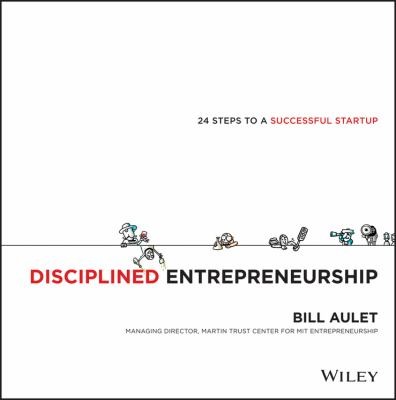
Talk to Disciplined Entrepreneurship like its author wrote you back.
Get the ideas that fit your life — not generic summaries.
- Chat with the book
- Audiobook-style main ideas
- Adapts to your life and goals
- Helps you take action
What it argues
Bill Aulet's Disciplined Entrepreneurship is a structured walkthrough of 24 steps for building a new venture, developed from MIT's entrepreneurship curriculum and Aulet's own experience as a serial entrepreneur. The title is deliberate: Aulet argues that entrepreneurship is not purely an art form practiced by naturally gifted visionaries but a discipline that can be taught, learned, and repeated with better outcomes when done systematically.
The 24 steps are grouped into six themes: who is your customer, what can you do for your customer, how does your customer acquire your product, how do you make money, how do you design and build your product, and how do you scale your business. The sequence matters — each step builds on the previous one, and Aulet is explicit about why founders who jump ahead tend to revisit earlier steps expensively. The first six steps alone — market segmentation, selecting a beachhead market, profiling the end user, calculating the total addressable market, defining the persona, and calculating the full lifecycle use case — are more analytical rigor than most first-time founders apply to their entire initial plan.
What it gets right
- 1.
Entrepreneurship is a discipline, not an innate talent. Systematic process produces better outcomes than relying on instinct or charisma alone.
- 2.
The beachhead market is the single customer segment you win first before expanding. Focusing there creates a repeatable, referenceable base rather than diluting effort across too many targets.
- 3.
Total addressable market calculations are only meaningful after you've defined the specific segment and use case. A top-down TAM estimate tells you almost nothing useful.
What it covers
Who wrote it
Bill Aulet is the Managing Director of the Martin Trust Center for MIT Entrepreneurship and a senior lecturer at MIT Sloan School of Management. Before joining MIT he was a serial entrepreneur, having co-founded or led several technology companies including Cambridge Decision Dynamics and SensAble Technologies. He has been recognized as one of the leading thinkers in entrepreneurship education globally. Disciplined Entrepreneurship, published in 2013, grew from his MIT course and has been used in entrepreneurship programs at universities worldwide.
