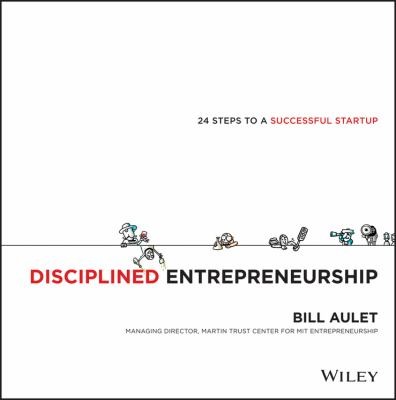
Disciplined Entrepreneurship by Bill Aulet is a 2013 business book about entrepreneurship, product-market fit, startups. Entrepreneurship is a discipline, not an innate talent. Systematic process produces better outcomes than relying on instinct or charisma alone.
Summary
Bill Aulet's Disciplined Entrepreneurship is a structured walkthrough of 24 steps for building a new venture, developed from MIT's entrepreneurship curriculum and Aulet's own experience as a serial entrepreneur. The title is deliberate: Aulet argues that entrepreneurship is not purely an art form practiced by naturally gifted visionaries but a discipline that can be taught, learned, and repeated with better outcomes when done systematically.
The 24 steps are grouped into six themes: who is your customer, what can you do for your customer, how does your customer acquire your product, how do you make money, how do you design and build your product, and how do you scale your business. The sequence matters — each step builds on the previous one, and Aulet is explicit about why founders who jump ahead tend to revisit earlier steps expensively. The first six steps alone — market segmentation, selecting a beachhead market, profiling the end user, calculating the total addressable market, defining the persona, and calculating the full lifecycle use case — are more analytical rigor than most first-time founders apply to their entire initial plan.
The beachhead market concept is the most distinctive contribution. Aulet argues that trying to address multiple markets simultaneously kills focus and makes sales repeatable by no one. The disciplined approach is to pick one segment, win it completely, then use it as a base for adjacent markets. This is counter-intuitive in an era that celebrates thinking big from day one, but it's well-grounded in how successful technology companies actually expanded.
Where the book is strong it is very strong: the frameworks for customer segmentation, persona development, and business model design are among the most rigorous available for early-stage founders. Where it is weaker is in its relative silence on execution and culture. The 24 steps describe what to know and decide, less what to do when the market doesn't respond the way the framework predicts.
Talk to Disciplined Entrepreneurship like its author wrote you back.
Get the ideas that fit your life — not generic summaries.
- Chat with the book
- Audiobook-style main ideas
- Adapts to your life and goals
- Helps you take action
Key takeaways
- 1.
Entrepreneurship is a discipline, not an innate talent. Systematic process produces better outcomes than relying on instinct or charisma alone.
- 2.
The beachhead market is the single customer segment you win first before expanding. Focusing there creates a repeatable, referenceable base rather than diluting effort across too many targets.
- 3.
Total addressable market calculations are only meaningful after you've defined the specific segment and use case. A top-down TAM estimate tells you almost nothing useful.
- 4.
The persona is not a demographic sketch. It's a detailed profile of a specific real person whose problem and context you understand well enough to predict their buying behavior.
- 5.
The full lifecycle use case maps every interaction a customer has with your product from first awareness to disposal. Most founders only design the happy path.
- 6.
Competitive moats must be built deliberately. Listing competitors and claiming differentiation is not the same as designing barriers that compound over time.
- 7.
Pricing should be set by the value you create for the customer, not by what competitors charge. Value-based pricing requires actually knowing what the full lifecycle use case is worth.
- 8.
The 24 steps are sequential by design. Founders who skip customer segmentation to start building the product typically return to earlier steps after expensive missteps.
Discussion questions
Use these on your own, with a book club, or as chat starters in Superbook. Book club version, ready to copy or print →
- 1.
Aulet argues that entrepreneurship is a discipline, not a born trait. How does that frame change how you think about who can or should start a company?
- 2.
Which step in the 24 do you think most founders in your industry skip or rush through, and what's the typical consequence?
- 3.
Walk through the beachhead market concept for a business you know. Is the beachhead as narrow and winnable as the framework suggests it should be?
- 4.
Aulet's persona work requires knowing a specific real person in depth. How well do you actually know your target customer, and what would it take to know them as well as the framework demands?
- 5.
Where does the total addressable market in your field get inflated or miscalculated, and who benefits from the inflation?
- 6.
The book is built on MIT's entrepreneurship curriculum. What does the academic framing add or remove compared to advice from a practitioner who has only built companies?
- 7.
How do you decide when you've won the beachhead market well enough to expand to adjacent markets?
- 8.
The full lifecycle use case covers everything from pre-purchase to disposal. Which part of that lifecycle does your company understand least well, and how much does that gap cost you?
- 9.
Competitive positioning in the book is rigorous and structured. How does that compare to how positioning decisions actually get made in companies you've been part of?
- 10.
Value-based pricing requires knowing what the use case is worth to the customer. What would you have to measure to set prices that way in your market?
- 11.
The 24 steps assume a linear process. What happens when the market forces you to revisit earlier steps while you're already executing on later ones?
- 12.
Aulet developed this framework at MIT. What does it capture well about technology startups that it might miss about other kinds of new ventures?
Themes
Frequently asked questions
-
What is Disciplined Entrepreneurship about?
It presents a 24-step framework for building a new venture, developed from MIT's entrepreneurship curriculum. The steps move from customer segmentation and persona development through product design, business model, and scaling, with an emphasis on rigor and sequence over speed.
-
Is Disciplined Entrepreneurship worth reading?
Yes, particularly for technical founders who are stronger builders than salespeople. The customer segmentation and persona frameworks are among the most rigorous available. Some readers find the 24-step structure overly mechanical, but working through even half the steps carefully produces more clarity than most informal planning processes.
-
How does Disciplined Entrepreneurship compare to The Lean Startup?
They're complementary. The Lean Startup emphasizes rapid experimentation and pivoting; Disciplined Entrepreneurship emphasizes deep customer analysis before building. Lean is faster and more iterative; Disciplined is more thorough upfront. Most successful startups use elements of both.
-
Who should read Disciplined Entrepreneurship?
First-time founders, especially technical ones who underinvest in customer and market analysis. Also useful for entrepreneurship educators and startup accelerator mentors who want a structured curriculum. Less useful if you're already well into execution and looking for operational guidance.
-
What is the beachhead market and why does it matter?
The beachhead is the single, narrow customer segment a startup should win completely before expanding to adjacent markets. Aulet argues that failing to narrow focus this way makes the sales process impossible to repeat. The name comes from military strategy: establish a foothold first, then push out.
Similar books
Zero to One: Notes on Startups, or How to Build the Future
Peter Thiel

Traction: Get a Grip on Your Business
Gino Wickman

Competing Against Luck
Clayton M. Christensen
Blue Ocean Strategy
W. Chan Kim and Renée Mauborgne
