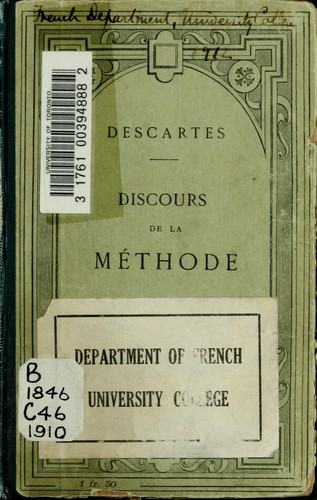
Talk to Discourse on the Method like its author wrote you back.
Get the ideas that fit your life — not generic summaries.
- Chat with the book
- Audiobook-style main ideas
- Adapts to your life and goals
- Helps you take action
What it argues
The Discourse on the Method is Descartes' intellectual autobiography and the founding document of modern Western philosophy. Written in French rather than Latin so that it could reach educated readers beyond the universities, it was published in 1637 as a preface to three scientific essays on optics, meteorology, and geometry. The brief philosophical text in the middle is what endured: Descartes' account of how he arrived at the method of systematic doubt and what he found at its foundation.
Descartes describes his dissatisfaction with the education he received, which offered a mass of contradictory opinions without any secure foundation. His project was to rebuild knowledge from scratch using a single reliable method: accept nothing as true that you have not clearly and distinctly perceived to be true; divide problems into the smallest parts; proceed from simple to complex; and review thoroughly to avoid omissions. This four-part method reflects his mathematical training and his conviction that certainty, once found, could be extended systematically.
What it gets right
- 1.
The method of systematic doubt asks us to reject everything that can be doubted, no matter how slightly, in order to find what is genuinely certain.
- 2.
'Cogito ergo sum' — I think, therefore I am — is the one truth that survives radical doubt, because the act of doubting requires a doubter.
- 3.
The four-part method: accept only what is clear and distinct; divide problems into parts; proceed from simple to complex; review completely to avoid omissions.
What it covers
Who wrote it
René Descartes (1596–1650) was a French philosopher, mathematician, and scientist widely regarded as the father of modern Western philosophy. He invented analytic geometry, made contributions to optics and physics, and developed the mind-body dualism that shaped centuries of subsequent debate. His major philosophical works include the Discourse on the Method (1637), Meditations on First Philosophy (1641), and Principles of Philosophy (1644). He spent much of his adult life in the Netherlands, where the climate of religious tolerance allowed him greater freedom than France. He died in Stockholm after accepting an invitation from Queen Christina of Sweden.
