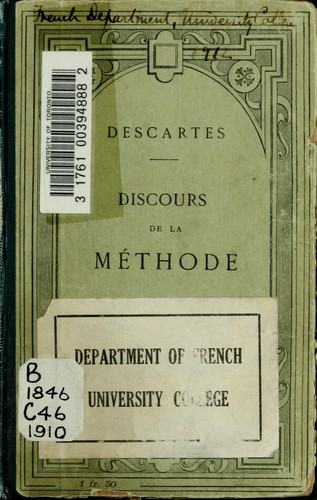
Discourse on the Method by René Descartes is a 1637 philosophy book about knowledge, doubt, reason. The method of systematic doubt asks us to reject everything that can be doubted, no matter how slightly, in order to find what is genuinely certain.
Summary
The Discourse on the Method is Descartes' intellectual autobiography and the founding document of modern Western philosophy. Written in French rather than Latin so that it could reach educated readers beyond the universities, it was published in 1637 as a preface to three scientific essays on optics, meteorology, and geometry. The brief philosophical text in the middle is what endured: Descartes' account of how he arrived at the method of systematic doubt and what he found at its foundation.
Descartes describes his dissatisfaction with the education he received, which offered a mass of contradictory opinions without any secure foundation. His project was to rebuild knowledge from scratch using a single reliable method: accept nothing as true that you have not clearly and distinctly perceived to be true; divide problems into the smallest parts; proceed from simple to complex; and review thoroughly to avoid omissions. This four-part method reflects his mathematical training and his conviction that certainty, once found, could be extended systematically.
The philosophical core arrives when Descartes applies radical doubt. He imagines that a malicious demon might be deceiving him about everything — the external world, mathematics, even the contents of his own mind. What survives? The very act of doubting proves one thing: there must be something doing the doubting. "Cogito ergo sum" — I think, therefore I am — is the one indubitable truth, the foundation on which the whole edifice of knowledge will be rebuilt. From this Descartes reconstructs his belief in God and the external world, though these arguments have satisfied very few subsequent readers.
The Discourse is short, personal, and unusually readable for a canonical philosophical text. It models a kind of intellectual courage — the willingness to tear down everything you think you know and start over — that influenced both the scientific revolution and the Enlightenment project of subjecting all inherited beliefs to rational scrutiny. The Meditations on First Philosophy, published five years later, develops the same project in more rigorous form.
Talk to Discourse on the Method like its author wrote you back.
Get the ideas that fit your life — not generic summaries.
- Chat with the book
- Audiobook-style main ideas
- Adapts to your life and goals
- Helps you take action
Key takeaways
- 1.
The method of systematic doubt asks us to reject everything that can be doubted, no matter how slightly, in order to find what is genuinely certain.
- 2.
'Cogito ergo sum' — I think, therefore I am — is the one truth that survives radical doubt, because the act of doubting requires a doubter.
- 3.
The four-part method: accept only what is clear and distinct; divide problems into parts; proceed from simple to complex; review completely to avoid omissions.
- 4.
Clear and distinct perception — not authority, tradition, or sensory experience — is Descartes' criterion for genuine knowledge.
- 5.
The mind-body distinction: the mind is a thinking, unextended substance; the body is an extended, unthinking substance. Their relationship is the 'Cartesian problem' that haunts subsequent philosophy.
- 6.
Descartes argues that a good God would not deceive us about the external world, reinstating knowledge of the physical after it survived systematic doubt — an argument widely criticized as circular.
- 7.
Writing in French, not Latin, Descartes signals that philosophical inquiry belongs to anyone who reasons carefully, not only to university-trained scholars.
- 8.
The Discourse models intellectual humility as method: the right starting point is not to trust your education but to question it completely and rebuild from a secure foundation.
Discussion questions
Use these on your own, with a book club, or as chat starters in Superbook. Book club version, ready to copy or print →
- 1.
Descartes' method begins by questioning everything you believe. Have you ever applied that kind of radical self-examination to your own convictions? What held up, and what didn't?
- 2.
The cogito — I think, therefore I am — is the most famous single sentence in philosophy. Does it seem like a genuine discovery or a tautology to you?
- 3.
Descartes was careful not to publish certain scientific conclusions because he feared the fate Galileo had suffered. What does that tell you about the relationship between radical thought and social constraint?
- 4.
The mind-body problem that Descartes established — how can an immaterial mind cause anything in a material body? — is still unresolved. Is it a genuine problem, or a problem created by the wrong assumptions?
- 5.
Descartes says we should accept only what we clearly and distinctly perceive. Is 'clear and distinct perception' a reliable criterion? What about things that feel certain but turn out to be wrong?
- 6.
He wrote this for a general audience, not other philosophers. What is gained or lost when philosophy is made accessible to non-specialists?
- 7.
The argument that a good God would not deceive us about the external world has struck most subsequent philosophers as circular. Does it seem circular to you? Does that matter for the project?
- 8.
Descartes tore down his intellectual house to rebuild on a secure foundation. Is that kind of systematic reconstruction ever possible, or do we always build on prior assumptions we can't fully examine?
- 9.
The scientific method as we practice it descends partly from Descartes. How does his four-step method compare to how you actually solve difficult problems?
- 10.
What would be the equivalent of the evil demon hypothesis today — the most disorienting possibility you could imagine that undermines ordinary certainty?
- 11.
Descartes says he trained in the best schools and found only confusion and contradiction. Is that still a fair description of formal education in some domains?
Themes
Frequently asked questions
-
What is the main argument of the Discourse on the Method?
That genuine knowledge requires a method — specifically, systematic doubt followed by acceptance only of what is clearly and distinctly perceived. Descartes finds the one certain foundation in the cogito and uses it to reconstruct knowledge of God, the self, and the external world.
-
How long is the Discourse on the Method?
Around 60 pages in most editions. It reads quickly and accessibly compared to most canonical philosophical texts. The Meditations on First Philosophy, which develops the same project more rigorously, is also short.
-
What does 'cogito ergo sum' actually mean?
I think, therefore I am. The point is that the very act of doubting proves the existence of the doubter. Even if an evil demon is deceiving you about everything else, the deception requires that there be something being deceived — a thinking subject.
-
Is the Discourse on the Method still relevant?
Yes. It introduces ideas — the primacy of reason, systematic doubt, the mind-body distinction, the individual as the starting point of inquiry — that shaped the Enlightenment, modern science, and liberal political theory. Understanding it explains a great deal about how the modern West thinks.
-
What is the difference between the Discourse and the Meditations?
The Discourse is autobiographical and accessible, a self-description of how Descartes arrived at his method and its initial results. The Meditations is a more rigorous philosophical treatise presenting the same arguments as a series of structured meditations designed to be worked through slowly.