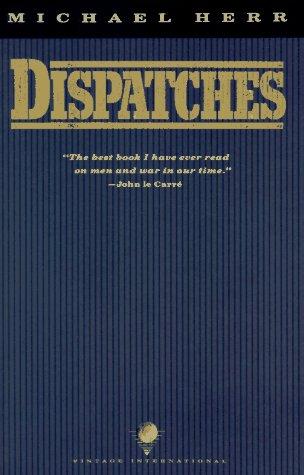
Talk to Dispatches like its author wrote you back.
Get the ideas that fit your life — not generic summaries.
- Chat with the book
- Audiobook-style main ideas
- Adapts to your life and goals
- Helps you take action
What it argues
Michael Herr went to Vietnam as a correspondent for Esquire in 1967 and spent eighteen months embedded with Marine and Army units before the experience broke him psychologically. Dispatches, published a decade later after years of writing and revision, is the book that came out of that time. It is not a conventional war memoir or a piece of journalism. Herr writes in a style that incorporates the rhythms of rock music, the argot of the soldiers he lived with, and a prose consciousness that is explicitly destabilized by what it witnessed.
The book has no conventional narrative structure. It proceeds through fragments: Khe Sanh under siege, the Tet Offensive in Hue, helicopter assaults, nights in bunkers, conversations with soldiers who have developed the particular dark humor of men who expect to die. Herr does not attempt to explain the war politically or strategically. He is interested in what the war felt like — the fear, the boredom, the adrenaline, the moral vacancy of a conflict in which the logic of survival had replaced every other value.
What it gets right
- 1.
Herr writes from inside the experience rather than outside it, producing prose that mimics the fragmentation and intensity of traumatic memory rather than imposing narrative coherence on events.
- 2.
The soldiers Herr portrays are neither heroes nor monsters. They are young men in an impossible situation, doing what they can to survive a war whose political logic they have largely stopped caring about.
- 3.
Khe Sanh, the subject of the book's longest section, was one of the most psychologically devastating engagements of the war — a siege that lasted months and whose strategic purpose was unclear even to the military commanders conducting it.
What it covers
Who wrote it
Michael Herr was an American journalist and screenwriter who covered Vietnam for Esquire from 1967 to 1969. After the war he suffered severe psychological effects that delayed completion of Dispatches for nearly a decade. He later co-wrote the narration for Francis Ford Coppola's Apocalypse Now (1979) and contributed to the screenplay for Stanley Kubrick's Full Metal Jacket (1987). Dispatches is his only book-length work of nonfiction. He also published a biographical essay on Walter Winchell and a memoir about Kubrick. Herr died in 2016.
