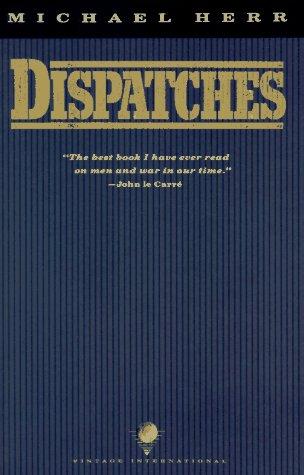
Dispatches by Michael Herr is a 1977 memoir book about vietnam war, war journalism, psychological trauma. Herr writes from inside the experience rather than outside it, producing prose that mimics the fragmentation and intensity of traumatic memory rather than imposing narrative coherence on events.
Summary
Michael Herr went to Vietnam as a correspondent for Esquire in 1967 and spent eighteen months embedded with Marine and Army units before the experience broke him psychologically. Dispatches, published a decade later after years of writing and revision, is the book that came out of that time. It is not a conventional war memoir or a piece of journalism. Herr writes in a style that incorporates the rhythms of rock music, the argot of the soldiers he lived with, and a prose consciousness that is explicitly destabilized by what it witnessed.
The book has no conventional narrative structure. It proceeds through fragments: Khe Sanh under siege, the Tet Offensive in Hue, helicopter assaults, nights in bunkers, conversations with soldiers who have developed the particular dark humor of men who expect to die. Herr does not attempt to explain the war politically or strategically. He is interested in what the war felt like — the fear, the boredom, the adrenaline, the moral vacancy of a conflict in which the logic of survival had replaced every other value.
The portrait of the soldiers is Dispatches's most lasting contribution. Herr was embedded with grunts rather than officers, and the men he writes about are young, mostly working-class, frequently terrified, and often very funny in a bleak register. They are not the heroes of World War II mythology or the drug-addled misfits of antiwar caricature. They are people in an impossible situation, doing what they can to stay alive, in a war whose stated purpose most of them have long since stopped believing.
Dispatches influenced every subsequent piece of American war writing. Herr later wrote the narration for Apocalypse Now and contributed to the screenplay for Full Metal Jacket. But the book itself remains the definitive literary account of what Vietnam felt like from the ground up. It is also one of the stranger and more formally inventive works of American nonfiction — a book that is partly memoir, partly journalism, and partly something harder to categorize that resembles what traumatic memory actually looks like.
Talk to Dispatches like its author wrote you back.
Get the ideas that fit your life — not generic summaries.
- Chat with the book
- Audiobook-style main ideas
- Adapts to your life and goals
- Helps you take action
Key takeaways
- 1.
Herr writes from inside the experience rather than outside it, producing prose that mimics the fragmentation and intensity of traumatic memory rather than imposing narrative coherence on events.
- 2.
The soldiers Herr portrays are neither heroes nor monsters. They are young men in an impossible situation, doing what they can to survive a war whose political logic they have largely stopped caring about.
- 3.
Khe Sanh, the subject of the book's longest section, was one of the most psychologically devastating engagements of the war — a siege that lasted months and whose strategic purpose was unclear even to the military commanders conducting it.
- 4.
The language of the soldiers — their slang, their dark humor, their particular way of talking around death — is itself a subject of the book. Herr treats the soldiers' vernacular as a form of survival technology.
- 5.
Herr was not a neutral observer. He carried weapons at times, participated in raids, and was permanently altered by the experience. Dispatches is partly about what reporting from a war zone does to the reporter.
- 6.
The Tet Offensive of 1968, which demonstrated that the optimistic official claims about the war's progress were false, runs through the book as a kind of catastrophic confirmation of what the soldiers already knew.
- 7.
Herr's influence on subsequent American war writing and filmmaking — Apocalypse Now, Full Metal Jacket, and many others — is direct and acknowledged. Dispatches changed the grammar of war representation in American culture.
Discussion questions
Use these on your own, with a book club, or as chat starters in Superbook. Book club version, ready to copy or print →
- 1.
Herr deliberately avoids imposing a linear narrative on his experience. What does that formal choice achieve that a conventional memoir could not?
- 2.
The soldiers in Dispatches have a very different relationship to the war's political justifications than the generals and politicians directing it. What explains that gap?
- 3.
Herr writes openly about carrying weapons and participating in operations rather than observing from a safe distance. What ethical questions does that raise about war journalism?
- 4.
The book was published ten years after the experiences it describes. What does that distance do to the writing, and what might have been different if Herr had published immediately?
- 5.
Khe Sanh is the book's central extended scene. What made it such an extreme psychological environment, and how does Herr render that extremity on the page?
- 6.
Herr treats soldiers' gallows humor as a survival mechanism. How does language function as protection against psychological disintegration under extreme stress?
- 7.
Dispatches influenced Apocalypse Now and Full Metal Jacket. How does the experience of those films compare to reading the book? What does each medium capture or lose?
- 8.
The book has no conventional political argument about the war. Does the accumulation of experience carry an implicit political position anyway?
- 9.
Herr writes that he was permanently altered by Vietnam. What does lasting psychological damage from reporting on war say about the costs of bearing witness professionally?
- 10.
The soldiers Herr portrays are mostly working-class. What does that demographic reality say about how the draft worked and who bore the war's costs?
- 11.
Dispatches was published in 1977, two years after the fall of Saigon. How does the timing of its publication affect how you read it?
Themes
Frequently asked questions
-
Is Dispatches worth reading?
Yes, if you want the most formally inventive and psychologically honest account of what Vietnam felt like from the ground. It is not a comfortable or easy read, and it does not explain the war politically. But it remains the definitive literary account of the experience, and its influence on American war writing is immense.
-
How long is Dispatches?
Around 260 pages. At average reading pace expect four to five hours. The fragmented, intense prose rewards slow reading, though the structure means you can also read it in sections.
-
What kind of book is it?
It is hard to categorize. Part memoir, part journalism, part literary experiment. It reads more like a novel than a war report, with prose that incorporates rock and roll rhythms, soldiers' slang, and a consciousness that is openly fractured by what it experienced.
-
Do I need to know the history of Vietnam to read it?
Basic familiarity helps, but Herr is not writing history. He assumes you know what the war is and focuses entirely on what it felt like. Some knowledge of the siege of Khe Sanh and the Tet Offensive enriches the reading but is not required.
-
Why did it take Herr ten years to publish the book?
The psychological damage from his time in Vietnam was severe, and the writing took years of work and revision. Herr has said that he effectively spent most of the 1970s trying to process what he had witnessed before he could shape it into a publishable form.
Similar books

The Forever War
Dexter Filkins
The Things They Carried
Tim O'Brien
Unbroken: A World War II Story of Survival, Resilience, and Redemption
Laura Hillenbrand
Say Nothing: A True Story of Murder and Memory in Northern Ireland
Patrick Radden Keefe
