Talk to Do Less, Get More like its author wrote you back.
Get the ideas that fit your life — not generic summaries.
- Chat with the book
- Audiobook-style main ideas
- Adapts to your life and goals
- Helps you take action
What it argues
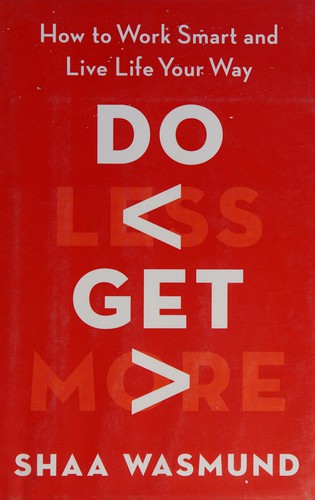
Do Less, Get More is Shaa Wasmund's argument that most people's productivity problem is not a shortage of effort or time but an excess of wrong activity. Wasmund, a British entrepreneur and business advisor, writes from the perspective of someone who spent years in high-visibility busyness before realizing that her highest-value work occupied only a fraction of her calendar. The book is short and direct: it makes the case for ruthless prioritization, then gives practical tools to do it.
The central idea is that busyness has become a social currency — a way of signaling importance and commitment that has little relationship to actual output. Wasmund argues that the first step is distinguishing between activity and achievement, and that most people avoid this distinction because inactivity feels like failure even when the activity is generating noise rather than value. She introduces what she calls the 80/20 audit applied to daily work: identifying the 20 percent of tasks that produce 80 percent of meaningful results, and systematically eliminating or delegating the rest.
What it gets right
- 1.
Busyness is not the same as productivity. Filling a calendar signals commitment but rarely correlates with the output that actually matters.
- 2.
An 80/20 audit of your daily tasks — identifying the 20 percent that produces 80 percent of your results — is the starting point for meaningful simplification.
- 3.
Saying no is a skill that requires practice, scripts, and the willingness to accept short-term discomfort to protect long-term focus.
What it covers
Who wrote it
Shaa Wasmund is a British entrepreneur, author, and business advisor. She has founded several companies and was named one of the UK's most influential women in business by the Sunday Times. She writes and speaks on productivity, entrepreneurship, and the habits of effective business owners, primarily addressing small business owners and self-employed professionals. Do Less, Get More is her most widely read book and draws on her own experience running businesses while managing the competing demands of public visibility.
