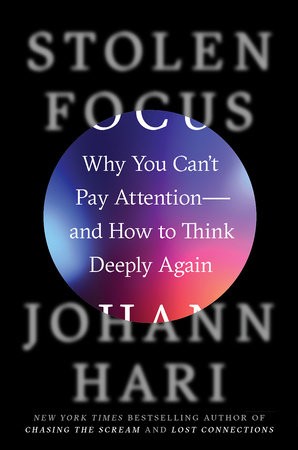
Talk to Stolen Focus: Why You Can't Pay Attention—and How to Think Deeply Again like its author wrote you back.
Get the ideas that fit your life — not generic summaries.
- Chat with the book
- Audiobook-style main ideas
- Adapts to your life and goals
- Helps you take action
What it argues
Johann Hari's argument is that the collapse of attention is not a personal failing but a political crisis. After three months offline in Provincetown and three years of interviews with scientists, technologists, and activists, Hari concludes that twelve systemic forces are degrading attention across rich societies: surveillance capitalism, sleep deprivation, diet, environmental pollution, the collapse of reading, and more. The attention crisis, on his account, is manufactured and reversible, but only if you understand where it came from.
The book moves between memoir and journalism. Hari narrates his own attempts to regain focus — a phone detox, a return to reading long books, experiments with ADHD diagnosis — alongside conversations with researchers including Nir Eyal, Tristan Harris, and James Williams. The first half catalogues the forces destroying attention; the second half surveys potential solutions, from individual changes to collective political action. The tone is accessible and at times deliberately personal, in the style of Hari's earlier Lost Connections.
What it gets right
- 1.
The collapse of attention is not a personal weakness. It is a systemic problem engineered by the business models of surveillance capitalism.
- 2.
Social media platforms are designed to maximize time-on-app through intermittent reinforcement, outrage cycles, and the weaponization of social comparison.
- 3.
Sleep deprivation is one of the most underrated causes of attention problems. The research on its effects on cognitive function is clear and largely ignored.
What it covers
Who wrote it
Johann Hari is a British journalist and author who writes about mental health, addiction, and the social determinants of human behavior. His previous book, Chasing the Scream, investigated the war on drugs through a century of reporting; Lost Connections examined the social causes of depression. Hari has written for The Independent, The New York Times, and The Guardian. He lives in London and speaks widely on attention, technology, and mental health policy. Stolen Focus was a New York Times bestseller.
