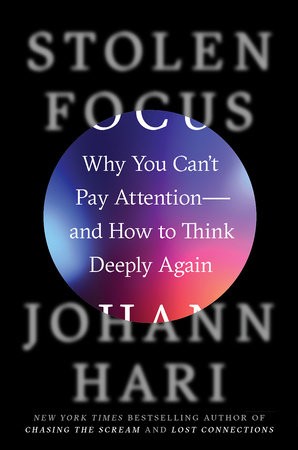
Talk to Stolen Focus: Why You Can't Pay Attention—and How to Think Deeply Again like its author wrote you back.
Get the ideas that fit your life — not generic summaries.
- Chat with the book
- Audiobook-style main ideas
- Adapts to your life and goals
- Helps you take action
Stolen Focus: Why You Can't Pay Attention—and How to Think Deeply Again, in detail
Johann Hari's argument is that the collapse of attention is not a personal failing but a political crisis. After three months offline in Provincetown and three years of interviews with scientists, technologists, and activists, Hari concludes that twelve systemic forces are degrading attention across rich societies: surveillance capitalism, sleep deprivation, diet, environmental pollution, the collapse of reading, and more. The attention crisis, on his account, is manufactured and reversible, but only if you understand where it came from.
The book moves between memoir and journalism. Hari narrates his own attempts to regain focus — a phone detox, a return to reading long books, experiments with ADHD diagnosis — alongside conversations with researchers including Nir Eyal, Tristan Harris, and James Williams. The first half catalogues the forces destroying attention; the second half surveys potential solutions, from individual changes to collective political action. The tone is accessible and at times deliberately personal, in the style of Hari's earlier Lost Connections.
The technology critique is the book's sharpest section. Hari draws on research showing that social media platforms are designed to maximize engagement through intermittent reinforcement, outrage, and the illusion of social reward. The business model of surveillance capitalism requires fracturing attention and selling it. Harris, a former Google design ethicist, argues that the attention economy is not a side effect of modern technology but its core logic. Hari is sympathetic to the view that individual behavior change is insufficient without structural reform of these incentive systems.
Where the book overreaches is in its scope. Twelve causes listed as equally responsible for a single crisis is a structural problem: not all of them are as well-evidenced as others, and the chapter on pollution, while alarming, sits uneasily alongside the chapters on app design. Readers looking for tight causal arguments will find the journalism more persuasive than the synthesis. Still, as a map of everything pulling at modern attention, Stolen Focus is thorough, readable, and usefully alarming.
The big ideas
- 1.
The collapse of attention is not a personal weakness. It is a systemic problem engineered by the business models of surveillance capitalism.
- 2.
Social media platforms are designed to maximize time-on-app through intermittent reinforcement, outrage cycles, and the weaponization of social comparison.
- 3.
Sleep deprivation is one of the most underrated causes of attention problems. The research on its effects on cognitive function is clear and largely ignored.
