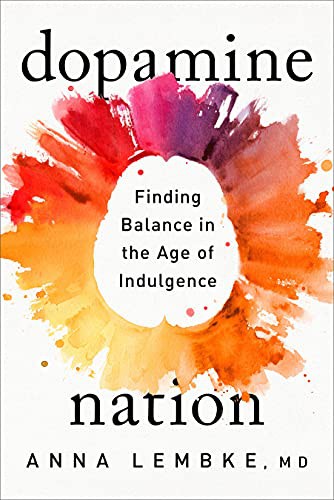
Talk to Dopamine Nation: Finding Balance in the Age of Indulgence like its author wrote you back.
Get the ideas that fit your life — not generic summaries.
- Chat with the book
- Audiobook-style main ideas
- Adapts to your life and goals
- Helps you take action
Dopamine Nation: Finding Balance in the Age of Indulgence, in detail
Dopamine Nation is psychiatrist Anna Lembke's account of how modern life has engineered an environment of endless easy pleasure — and what that does to the brain. Lembke runs Stanford's addiction medicine clinic and the book moves between neuroscience, clinical case studies, and her own personal confession: she became hooked on a series of romance novels and had to apply the same recovery tools she gives patients. That combination of clinical authority and personal candor makes the book unusual in its field.
The central argument is a neurobiological one: pleasure and pain are processed in overlapping brain regions and work like a seesaw. A dopamine hit tilts the seesaw toward pleasure, but the brain compensates by tilting it the other way, which is why the high fades and the low follows. With repeated stimulation, the brain recalibrates: the baseline tilts permanently toward pain, and you need more of the substance or behavior just to feel normal. Lembke calls this the dopamine deficit state. It explains tolerance, craving, and the paradox of compulsive behavior that no longer feels good.
Her prescription is what she calls a dopamine fast — a period of complete abstinence from the problematic stimulus, usually four weeks, during which the brain's hedonic thermostat resets. The case studies here are the book's best material: a man addicted to pornography, a young woman addicted to self-harm, a doctor addicted to marijuana, each following roughly the same arc of escalation and withdrawal before arriving at a more sustainable relationship with pleasure.
Lembke also introduces the idea of "pressing on the pain side" as a counterintuitive strategy: deliberate discomfort — cold showers, exercise, fasting — tilts the seesaw in the opposite direction and produces a lasting mood improvement. This section is short but has influenced the popular interest in ice baths and similar practices. The book is lean, readable, and clinically grounded, though readers looking for deep philosophical engagement with questions of freedom and addiction will find it somewhat thin on that front.
The big ideas
- 1.
Pleasure and pain share the same neurological machinery and operate like a seesaw: a hit of pleasure triggers a compensating tilt toward discomfort.
- 2.
Repeated stimulation recalibrates the brain's baseline downward. You eventually need the drug or behavior just to feel neutral, not to feel good.
- 3.
Lembke calls this the dopamine deficit state: a persistent low-grade anxiety and anhedonia that underlies most compulsive consumption.
