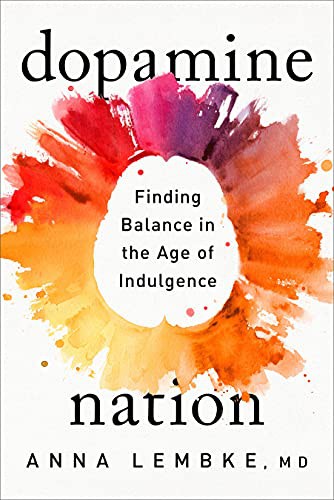
Dopamine Nation: Finding Balance in the Age of Indulgence by Anna Lembke is a 2021 psychology book about addiction, dopamine, self-regulation. Pleasure and pain share the same neurological machinery and operate like a seesaw: a hit of pleasure triggers a compensating tilt toward discomfort.
Summary
Dopamine Nation is psychiatrist Anna Lembke's account of how modern life has engineered an environment of endless easy pleasure — and what that does to the brain. Lembke runs Stanford's addiction medicine clinic and the book moves between neuroscience, clinical case studies, and her own personal confession: she became hooked on a series of romance novels and had to apply the same recovery tools she gives patients. That combination of clinical authority and personal candor makes the book unusual in its field.
The central argument is a neurobiological one: pleasure and pain are processed in overlapping brain regions and work like a seesaw. A dopamine hit tilts the seesaw toward pleasure, but the brain compensates by tilting it the other way, which is why the high fades and the low follows. With repeated stimulation, the brain recalibrates: the baseline tilts permanently toward pain, and you need more of the substance or behavior just to feel normal. Lembke calls this the dopamine deficit state. It explains tolerance, craving, and the paradox of compulsive behavior that no longer feels good.
Her prescription is what she calls a dopamine fast — a period of complete abstinence from the problematic stimulus, usually four weeks, during which the brain's hedonic thermostat resets. The case studies here are the book's best material: a man addicted to pornography, a young woman addicted to self-harm, a doctor addicted to marijuana, each following roughly the same arc of escalation and withdrawal before arriving at a more sustainable relationship with pleasure.
Lembke also introduces the idea of "pressing on the pain side" as a counterintuitive strategy: deliberate discomfort — cold showers, exercise, fasting — tilts the seesaw in the opposite direction and produces a lasting mood improvement. This section is short but has influenced the popular interest in ice baths and similar practices. The book is lean, readable, and clinically grounded, though readers looking for deep philosophical engagement with questions of freedom and addiction will find it somewhat thin on that front.
Talk to Dopamine Nation: Finding Balance in the Age of Indulgence like its author wrote you back.
Get the ideas that fit your life — not generic summaries.
- Chat with the book
- Audiobook-style main ideas
- Adapts to your life and goals
- Helps you take action
Key takeaways
- 1.
Pleasure and pain share the same neurological machinery and operate like a seesaw: a hit of pleasure triggers a compensating tilt toward discomfort.
- 2.
Repeated stimulation recalibrates the brain's baseline downward. You eventually need the drug or behavior just to feel neutral, not to feel good.
- 3.
Lembke calls this the dopamine deficit state: a persistent low-grade anxiety and anhedonia that underlies most compulsive consumption.
- 4.
A dopamine fast — four weeks of abstinence — allows the brain's hedonic set point to reset. Most patients report that neutral begins to feel good again.
- 5.
Pressing on the pain side through deliberate discomfort (cold exposure, hard exercise, fasting) produces a lasting dopamine boost by triggering the brain's own compensatory response.
- 6.
Radical honesty, about what you're consuming and why, is itself a therapeutic tool. Lembke uses it with patients and applied it to her own romance novel habit.
- 7.
The abundance of cheap, high-dopamine stimuli in modern life has made low-grade addiction a near-universal condition, not a pathology confined to a small minority.
- 8.
Recovery is not about returning to moderate use in most cases. The brain's recalibration toward a substance or behavior is often permanent enough that abstinence is easier than moderation.
Discussion questions
Use these on your own, with a book club, or as chat starters in Superbook. Book club version, ready to copy or print →
- 1.
Lembke argues that modern life has industrialized pleasure. What high-dopamine habit in your own life feels compulsive rather than chosen?
- 2.
The seesaw model suggests every pleasure comes with a cost. Does knowing that change how you think about activities you enjoy?
- 3.
Lembke herself became addicted to romance novels. What does it say about addiction that a psychiatrist specializing in it wasn't immune?
- 4.
Have you ever tried a deliberate fast from something you consumed habitually? What happened to your craving after the abstinence period?
- 5.
Pressing on the pain side — cold showers, hard exercise, fasting — feels counterintuitive as a path to wellbeing. Have you experienced something like this working?
- 6.
The book frames many behaviors we call habits or preferences as falling on a spectrum with clinical addiction. Is that framing useful or does it dilute the meaning of addiction?
- 7.
Lembke's patients often describe their addictive substance as their closest relationship. What does that reveal about what drives compulsive behavior beyond biology?
- 8.
The dopamine deficit state — the persistent low that follows compulsive use — is hard to distinguish from ordinary unhappiness. How would you tell the difference?
- 9.
Radical honesty is presented as a treatment. What would you have to be honest about, with yourself or others, to apply that idea in your own life?
- 10.
The four-week abstinence recommendation feels arbitrary. Why four weeks? What does the variability in individual brain recalibration mean for prescriptions like this?
- 11.
Lembke distinguishes between pain that is healing and pain that is harmful. How do you make that distinction in your own life?
- 12.
The book ends on a note of cautious optimism about finding balance. Given the structural incentives built into social media, streaming, and food design, how realistic is that at a societal level?
Themes
Frequently asked questions
-
What is Dopamine Nation about?
It argues that modern society has engineered an environment of constant easy pleasure that overloads the brain's dopamine system, producing a low-grade form of addiction in most people. Lembke explains the neuroscience and offers clinical and personal case studies of people finding their way back to balance.
-
Is Dopamine Nation worth reading?
Yes, particularly if you've noticed a habit you can't comfortably stop. It's clinically grounded, personal, and short. The case studies are specific and memorable. Those wanting a deeper philosophical treatment of addiction will find it thin in places, but as a practical account it's unusually honest.
-
What is a dopamine fast?
A period of complete abstinence from a problematic stimulus — Lembke recommends four weeks — during which the brain's dopamine baseline resets. After the fast, patients typically report that ordinary pleasures feel rewarding again and that the compulsive pull of the original behavior weakens substantially.
-
Who should read Dopamine Nation?
Anyone who recognizes compulsive patterns in their use of food, pornography, social media, alcohol, drugs, or other high-stimulation experiences. It is also useful for therapists, physicians, and parents trying to understand the biology behind compulsive behavior in people they care for.
-
How long does it take to read Dopamine Nation?
About four to five hours. The book is under 300 pages, structured in short chapters with case studies that move quickly. It is dense in places where Lembke explains the neuroscience but never stays there long enough to lose a general reader.
Similar books
Dopamine Nation vs.
Deciding between two books? Dopamine Nation vs The Molecule of More .
