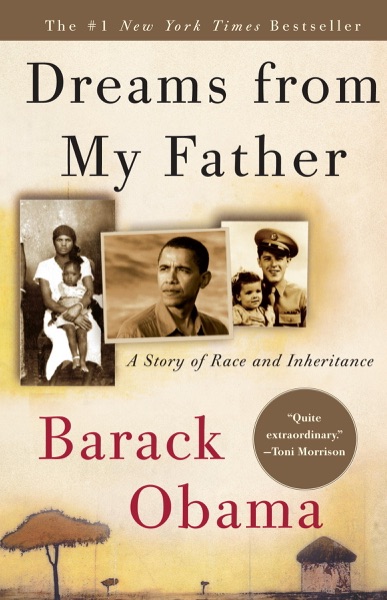
Talk to Dreams from My Father: A Story of Race and Inheritance like its author wrote you back.
Get the ideas that fit your life — not generic summaries.
- Chat with the book
- Audiobook-style main ideas
- Adapts to your life and goals
- Helps you take action
Dreams from My Father: A Story of Race and Inheritance, in detail
Barack Obama wrote Dreams from My Father in 1995, before entering politics, after being elected the first Black president of the Harvard Law Review. He intended it as a serious literary memoir rather than a political document, and it reads like one — carefully constructed, often lyrical, willing to sit with ambiguity rather than resolve it. The book is organized in three parts: childhood and adolescence in Hawaii and Indonesia; his years as a community organizer in Chicago; and a trip to Kenya to meet the family he had never known. Connecting all three is the search for a stable identity at the intersection of Black American experience and a specifically Kenyan lineage he had largely encountered through myth.
The Hawaii and Indonesia sections trace the peculiar situation of a biracial child raised by a white mother and her white Kansas parents in Honolulu, consciously seeking Black American identity through books, music, and eventually through a teenage experimentation with drugs and disaffection. Obama writes honestly about the confusion and occasional performance involved in this search: trying on identities that fit imperfectly, learning from Black friends and mentors what assumptions he was making about what Blackness required.
The Chicago section is the longest and most politically useful. Obama spent three years as a community organizer on the South Side, trying to build coalitions among Black churches and neighborhood associations to fight city hall over asbestos removal, job training, and school conditions. The work was often frustrating and the gains modest. What makes the section interesting is his account of how institutions actually function — the dynamics of trust and grievance, the difference between organizing around concrete material issues and organizing around symbolic ones, and his growing sense that systemic change required more power than community organizing alone could generate.
The Kenya section is the emotional center of the book. Meeting half-siblings, aunts, grandmothers, and hearing the full story of his father's life — a brilliant man who rose to prominence in Kenya's independence government and then destroyed himself through drinking and political miscalculation — gives Obama a way to understand what he had inherited and what he needed to make his own. The book ends with a kind of grief for the father he never knew and a tentative peace with what that absence had made of him. It is one of the more honest accounts of how people assemble a self from fragments of stories they cannot fully verify.
The big ideas
- 1.
Identity is assembled from inherited fragments and deliberate choices, not given whole. Obama's account of seeking Black identity in Hawaii demonstrates how consciously this construction often happens.
- 2.
Community organizing produces real gains but faces structural limits. Obama's Chicago experience showed that local coalitions can win specific material improvements while remaining unable to challenge the larger political economy that creates the problems.
- 3.
The father figures a person constructs from absence are often more powerful than present fathers. The mythologized version of Obama Sr. shaped his son more than the difficult real man would have.
