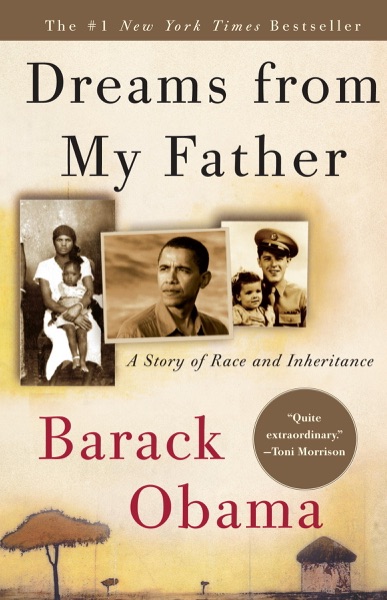
Dreams from My Father: A Story of Race and Inheritance by Barack Obama is a 1995 memoir book about identity, race, family. Identity is assembled from inherited fragments and deliberate choices, not given whole. Obama's account of seeking Black identity in Hawaii demonstrates how consciously this construction often happens.
Summary
Barack Obama wrote Dreams from My Father in 1995, before entering politics, after being elected the first Black president of the Harvard Law Review. He intended it as a serious literary memoir rather than a political document, and it reads like one — carefully constructed, often lyrical, willing to sit with ambiguity rather than resolve it. The book is organized in three parts: childhood and adolescence in Hawaii and Indonesia; his years as a community organizer in Chicago; and a trip to Kenya to meet the family he had never known. Connecting all three is the search for a stable identity at the intersection of Black American experience and a specifically Kenyan lineage he had largely encountered through myth.
The Hawaii and Indonesia sections trace the peculiar situation of a biracial child raised by a white mother and her white Kansas parents in Honolulu, consciously seeking Black American identity through books, music, and eventually through a teenage experimentation with drugs and disaffection. Obama writes honestly about the confusion and occasional performance involved in this search: trying on identities that fit imperfectly, learning from Black friends and mentors what assumptions he was making about what Blackness required.
The Chicago section is the longest and most politically useful. Obama spent three years as a community organizer on the South Side, trying to build coalitions among Black churches and neighborhood associations to fight city hall over asbestos removal, job training, and school conditions. The work was often frustrating and the gains modest. What makes the section interesting is his account of how institutions actually function — the dynamics of trust and grievance, the difference between organizing around concrete material issues and organizing around symbolic ones, and his growing sense that systemic change required more power than community organizing alone could generate.
The Kenya section is the emotional center of the book. Meeting half-siblings, aunts, grandmothers, and hearing the full story of his father's life — a brilliant man who rose to prominence in Kenya's independence government and then destroyed himself through drinking and political miscalculation — gives Obama a way to understand what he had inherited and what he needed to make his own. The book ends with a kind of grief for the father he never knew and a tentative peace with what that absence had made of him. It is one of the more honest accounts of how people assemble a self from fragments of stories they cannot fully verify.
Talk to Dreams from My Father: A Story of Race and Inheritance like its author wrote you back.
Get the ideas that fit your life — not generic summaries.
- Chat with the book
- Audiobook-style main ideas
- Adapts to your life and goals
- Helps you take action
Key takeaways
- 1.
Identity is assembled from inherited fragments and deliberate choices, not given whole. Obama's account of seeking Black identity in Hawaii demonstrates how consciously this construction often happens.
- 2.
Community organizing produces real gains but faces structural limits. Obama's Chicago experience showed that local coalitions can win specific material improvements while remaining unable to challenge the larger political economy that creates the problems.
- 3.
The father figures a person constructs from absence are often more powerful than present fathers. The mythologized version of Obama Sr. shaped his son more than the difficult real man would have.
- 4.
Race operates differently in different national contexts. The racial frameworks Obama encountered in Hawaii, Chicago, and Kenya were not simply versions of the same thing.
- 5.
Listening is the primary skill in community organizing. Obama describes spending months conducting hundreds of one-on-one interviews before identifying issues that could mobilize people.
- 6.
Family stories are political documents. What the Obama family in Kenya chose to tell and omit about his father's life was shaped by grief, shame, pride, and tribal politics.
- 7.
Biracial identity in America in the 1980s required choosing. The structural reality of American racism largely precluded a third option, whatever Obama's actual background.
- 8.
Grief can be generative. The trip to Kenya ends not in resolution but in a grief that Obama describes as freeing — releasing him from the need to complete his father's story.
Discussion questions
Use these on your own, with a book club, or as chat starters in Superbook. Book club version, ready to copy or print →
- 1.
Obama describes trying on Black identity as a teenager through books and behavior. Is that kind of deliberate identity construction authentic, or is it always somewhat performed?
- 2.
His community organizing work in Chicago produced modest gains over three years. What does that timeline suggest about what community organizing can and can't change?
- 3.
Obama's father was a brilliant man who died having squandered most of his potential. What does the book suggest about the relationship between intelligence, ambition, and self-destruction?
- 4.
The book was written before Obama entered politics. Does knowing his subsequent career change how you read it? What would be different if it had been written after?
- 5.
Obama is careful throughout to represent the perspectives of people who disagreed with him or each other. Is that restraint a virtue in memoir, or does it flatten things?
- 6.
How much of what you know about yourself came from stories others told you about yourself, rather than your own memory?
- 7.
Obama writes about the particular difficulty of being biracial in a society that expects you to pick a side. Has that pressure changed since 1995?
- 8.
The Kenya section depends on translation, selective memory, and stories passed through multiple tellers. How much can a person really learn about an ancestor this way?
- 9.
Obama describes a meeting with an old Chicago organizer who tells him that the churches are the only institution on the South Side that hasn't been corrupted. What institutions in your community play a similar structural role?
- 10.
The book ends with Obama watching his half-sister weep at their father's grave. What do you think he decided, in that moment, about what he was and wasn't going to inherit?
- 11.
Dreams from My Father was written when Obama was thirty-three. How does someone that young have the perspective to write honestly about their own formation?
- 12.
Is the book's literary quality — its careful construction and lyrical passages — a strength or does it make you trust it less as a factual account?
Themes
Frequently asked questions
-
Is Dreams from My Father worth reading?
Yes, particularly if you're interested in identity, race, and community organizing. It's genuinely well-written — more literary than most political memoirs — and the Chicago section offers an unusually honest account of what grassroots organizing actually looks like from the inside.
-
How long does it take to read Dreams from My Father?
Around eight to nine hours for the 460-page book at average pace. The prose is denser than Obama's later political speeches; several sections reward slow reading. The book was written to be read, not skimmed.
-
What is Dreams from My Father mainly about?
It's Obama's account of constructing a coherent identity from a fragmented inheritance: a Kenyan father he barely knew, a white American mother and grandparents, a childhood in Hawaii and Indonesia, years as a community organizer in Chicago, and a trip to Kenya to meet the family he had never known.
-
How accurate is Dreams from My Father?
Obama notes in the preface that some characters are composites and some dialogue is reconstructed. It should be read as a memoir, not a documentary record. Several relatives later disputed specific characterizations, particularly in the Kenya sections.
-
Who should read this book?
Readers interested in American racial politics, community organizing, memoir as literary form, or the formation of Barack Obama's political thinking. It provides context that his later presidential writing largely omits.