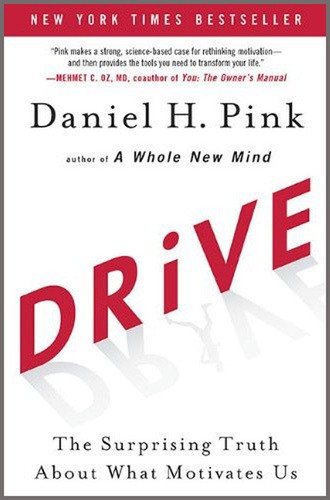
Talk to Drive: The Surprising Truth About What Motivates Us like its author wrote you back.
Get the ideas that fit your life — not generic summaries.
- Chat with the book
- Audiobook-style main ideas
- Adapts to your life and goals
- Helps you take action
What it argues
Drive is Daniel Pink's argument that the motivational model most organizations still run on — reward the behavior you want, punish the behavior you don't — is badly mismatched to the kind of work that matters most in a modern economy. Pink calls this the old operating system "Motivation 2.0," and draws on four decades of behavioral science research to show why external rewards consistently undermine performance on tasks that require creativity, judgment, or sustained problem-solving.
The alternative Pink proposes — "Motivation 3.0" — rests on three elements: autonomy, mastery, and purpose. Autonomy is the drive to direct our own lives. Mastery is the urge to get better at something that matters. Purpose is the desire to do what we do in the service of something larger than ourselves. Pink traces each through research: the Deci and Ryan self-determination theory, Harry Harlow's puzzle-solving monkeys, the "FedEx Days" that some companies run where employees spend twenty-four hours working on whatever they want. The pattern across these studies is consistent — when people feel in control of their work, focused on improvement, and connected to a reason that goes beyond a paycheck, they perform better and stay engaged longer.
What it gets right
- 1.
Extrinsic rewards — bonuses, grades, prizes — can crowd out intrinsic motivation on tasks that require creativity and judgment. Pink calls this the 'sawyer effect,' named for Tom Sawyer's fence.
- 2.
Motivation 3.0 rests on three elements: autonomy (control over your work), mastery (the drive to improve), and purpose (connection to something larger than yourself).
- 3.
Conditional 'if-then' rewards work for simple, algorithmic tasks but damage performance on tasks with no single right answer. The research on this is four decades old and largely ignored by managers.
What it covers
Who wrote it
Daniel H. Pink is an American author and speaker whose work focuses on human behavior, work, and management. Before writing full-time he served as chief speechwriter for Vice President Al Gore. He is the author of six books, including A Whole New Mind, To Sell Is Human, and When: The Scientific Secrets of Perfect Timing. His TED Talk on motivation, based on Drive, is one of the most-watched TED Talks of all time. He writes and speaks widely on how behavioral science applies to business and everyday life.
