Drive: The Surprising Truth About What Motivates Us by Daniel H. Pink is a 2009 psychology book about motivation, autonomy, mastery. Extrinsic rewards — bonuses, grades, prizes — can crowd out intrinsic motivation on tasks that require creativity and judgment. Pink calls this the 'sawyer effect,' named for Tom Sawyer's fence.
Summary
Drive is Daniel Pink's argument that the motivational model most organizations still run on — reward the behavior you want, punish the behavior you don't — is badly mismatched to the kind of work that matters most in a modern economy. Pink calls this the old operating system "Motivation 2.0," and draws on four decades of behavioral science research to show why external rewards consistently undermine performance on tasks that require creativity, judgment, or sustained problem-solving.
The alternative Pink proposes — "Motivation 3.0" — rests on three elements: autonomy, mastery, and purpose. Autonomy is the drive to direct our own lives. Mastery is the urge to get better at something that matters. Purpose is the desire to do what we do in the service of something larger than ourselves. Pink traces each through research: the Deci and Ryan self-determination theory, Harry Harlow's puzzle-solving monkeys, the "FedEx Days" that some companies run where employees spend twenty-four hours working on whatever they want. The pattern across these studies is consistent — when people feel in control of their work, focused on improvement, and connected to a reason that goes beyond a paycheck, they perform better and stay engaged longer.
The book's second half is more practical, if uneven. Pink gives advice on building autonomy into management (Results Only Work Environments, or ROWEs), on approaching mastery as a discipline rather than an endpoint, and on surfacing genuine purpose in how organizations communicate their mission. The business case studies are illustrative — Atlassian, Google's 20% time — but some of the prescriptions feel easier to apply in software companies than in hospitals, factories, or retail. Pink acknowledges this gap without fully resolving it.
Drive is most useful as a diagnostic. If you manage people and wonder why bonuses don't seem to produce the engagement you expect, or why your best performers drift toward projects of their own choosing, Pink gives you a coherent explanation grounded in actual research rather than folklore. It reads quickly, the science is accessible, and the central claim holds up: for work that requires thinking, intrinsic motivation is not a perk — it's the mechanism.
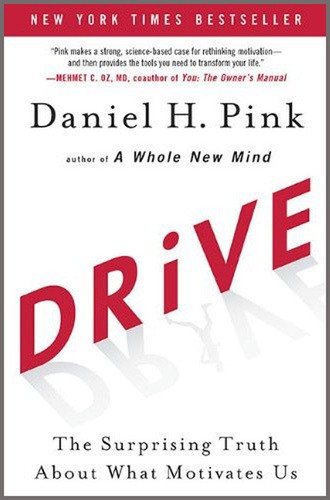
Talk to Drive: The Surprising Truth About What Motivates Us like its author wrote you back.
Get the ideas that fit your life — not generic summaries.
- Chat with the book
- Audiobook-style main ideas
- Adapts to your life and goals
- Helps you take action
Key takeaways
- 1.
Extrinsic rewards — bonuses, grades, prizes — can crowd out intrinsic motivation on tasks that require creativity and judgment. Pink calls this the 'sawyer effect,' named for Tom Sawyer's fence.
- 2.
Motivation 3.0 rests on three elements: autonomy (control over your work), mastery (the drive to improve), and purpose (connection to something larger than yourself).
- 3.
Conditional 'if-then' rewards work for simple, algorithmic tasks but damage performance on tasks with no single right answer. The research on this is four decades old and largely ignored by managers.
- 4.
Autonomy has four dimensions: task, time, technique, and team. Companies like Atlassian and Gore have used each one to unlock discretionary effort that structured management can't buy.
- 5.
Mastery is a mindset, not a destination. Pink draws on Carol Dweck's work on growth versus fixed mindset: people who see ability as improvable will persist through difficulty; people who see it as fixed avoid challenges that threaten their self-image.
- 6.
Purpose isn't a motivational poster on the wall. It shows up in how goals are framed, whether the company's words match its actions, and whether employees can draw a straight line from their daily work to an outcome that matters.
- 7.
Pay people enough to take money off the table — fairly, transparently, and without tying compensation to specific outcomes — then focus on creating conditions for intrinsic motivation to operate.
- 8.
Flow, Csikszentmihalyi's state of effortless engagement, happens at the edge between boredom and anxiety. Designing work so people regularly encounter tasks just above their current skill level is the closest thing to manufacturing it.
Discussion questions
Use these on your own, with a book club, or as chat starters in Superbook. Book club version, ready to copy or print →
- 1.
Pink argues that 'if-then' rewards reliably undermine creative work. Think of a time you were paid or rewarded to do something you had enjoyed before. Did the reward change how you felt about it?
- 2.
Of the three elements — autonomy, mastery, purpose — which one is most missing from work you've done? What would it have taken to add it?
- 3.
Which of the four dimensions of autonomy (task, time, technique, team) does your current work give you most of, and which does it withhold most tightly?
- 4.
Pink distinguishes between 'baseline rewards' — pay that takes money off the table — and performance bonuses. Does the compensation structure where you work or have worked match that model? How would it change behavior if it did?
- 5.
Mastery requires accepting that you'll be a novice for a long time. What skill or domain have you avoided seriously pursuing because the early incompetence felt too uncomfortable?
- 6.
The book argues that purpose works when it's embedded in daily work, not just announced from above. Where have you experienced that difference?
- 7.
Pink uses Google's 20% time and Atlassian's FedEx Days as examples of structured autonomy. What would the equivalent look like in a context you know well — a school, a hospital, a family?
- 8.
Results Only Work Environments judge employees purely on output, not hours or location. What would change about how your own work is evaluated if you switched to that model?
- 9.
Drive's critique is mostly aimed at managers and organizations. To what extent do you think individuals can create their own Motivation 3.0 conditions inside an organization not designed for them?
- 10.
Pink draws heavily on Deci and Ryan's self-determination theory. Where in your life outside work have you seen the three elements — autonomy, mastery, purpose — produce engagement you couldn't manufacture by trying harder?
- 11.
The book claims intrinsic motivation applies broadly, but most of the examples are knowledge workers at tech companies. How well do you think the framework travels to fields like manufacturing, teaching, or caregiving?
- 12.
Pink says mastery is asymptotic — you approach it but never reach it. Does that framing make sustained effort feel more worthwhile or less, for you personally?
Themes
Frequently asked questions
-
What is Drive by Daniel Pink about?
Drive argues that the carrot-and-stick model of motivation — reward good behavior, punish bad — works for simple tasks but actively harms performance on creative and complex work. Pink draws on behavioral science to make the case for autonomy, mastery, and purpose as more reliable drivers of sustained engagement.
-
Is Drive worth reading for managers?
Yes, particularly if your team does work that requires judgment or creativity. The book gives a research-backed diagnosis for why performance bonuses often disappoint and why your best people may be quietly disengaged. The prescriptions are harder to act on, but the diagnostic value alone justifies the read.
-
How long does it take to read Drive?
Around four to five hours at average reading pace. The book is 240 pages and moves quickly. The first half, which builds the research case, reads faster than the second half, where Pink applies the framework to management practice.
-
Who shouldn't read Drive?
If your work is primarily algorithmic — repetitive tasks with clear right answers and defined procedures — much of Pink's framework doesn't apply directly. He acknowledges this, but the book's energy is entirely toward knowledge work and creative roles.
-
What's the most actionable idea in Drive?
Separate baseline pay from performance incentives. Pink's prescription: pay people enough that money stops being a daily distraction, don't tie that pay to specific outcomes, and then focus energy on giving people control over their work, room to improve, and a reason that goes beyond the paycheck.
Similar books
Thinking, Fast and Slow
Daniel Kahneman

Mindset: The New Psychology of Success
Carol S. Dweck
Grit: The Power of Passion and Perseverance
Angela Duckworth
Start with Why
Simon Sinek
