Talk to Eat That Frog! like its author wrote you back.
Get the ideas that fit your life — not generic summaries.
- Chat with the book
- Audiobook-style main ideas
- Adapts to your life and goals
- Helps you take action
Eat That Frog!, in detail
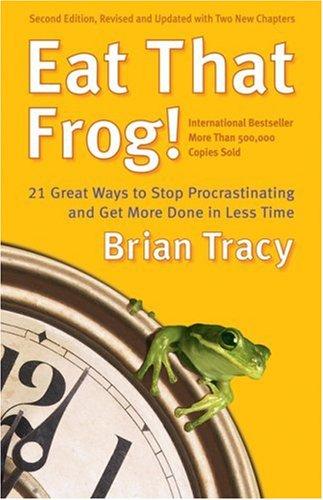
Eat That Frog! is Brian Tracy's short, direct manual for beating procrastination through systematic prioritization. The title comes from a Mark Twain observation: if you have to eat a live frog, do it first thing in the morning, and nothing worse will happen to you the rest of the day. Tracy applies this as a daily practice: identify your most important and most dreaded task, and do it before anything else.
Tracy's twenty-one techniques are organized around a core principle: personal effectiveness is about doing the most valuable things first, not doing more things faster. He introduces the ABCDE method for prioritizing tasks — A tasks are things you must do, B tasks are things you should do, C tasks are nice to do, D tasks should be delegated, and E tasks should be eliminated. The rule is never to do a B task while any A task remains undone.
The book's other central concept is the 80/20 rule applied to daily work: twenty percent of activities produce eighty percent of results. Most people spend their time on the easy, low-value eighty percent and leave the high-value twenty percent untouched. The discipline of identifying those high-leverage tasks and attacking them first is the entire game.
Tracy also emphasizes single-handling: starting an important task and working on it until it is complete without stopping. Interruptions and task-switching, he argues, waste far more time than people realize because of the warm-up cost of re-engaging. Each of the twenty-one chapters is short and practical, making this a book to read in one sitting and implement the same day.
The big ideas
- 1.
Eat your frog first: do your most important and most difficult task before anything else each morning. This single habit transforms daily output more than any time-management system.
- 2.
The ABCDE method separates tasks into five categories from must-do to eliminate. Never start a B task while any A task is incomplete.
- 3.
The 80/20 rule means 20% of activities produce 80% of results. Identifying and protecting time for the high-value 20% is more important than being efficient across all tasks.
