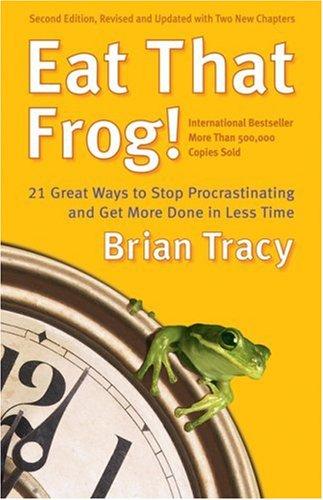
Eat That Frog! by Brian Tracy is a 2001 self-help book about procrastination, time management, productivity. Eat your frog first: do your most important and most difficult task before anything else each morning. This single habit transforms daily output more than any time-management system.
Summary
Eat That Frog! is Brian Tracy's short, direct manual for beating procrastination through systematic prioritization. The title comes from a Mark Twain observation: if you have to eat a live frog, do it first thing in the morning, and nothing worse will happen to you the rest of the day. Tracy applies this as a daily practice: identify your most important and most dreaded task, and do it before anything else.
Tracy's twenty-one techniques are organized around a core principle: personal effectiveness is about doing the most valuable things first, not doing more things faster. He introduces the ABCDE method for prioritizing tasks — A tasks are things you must do, B tasks are things you should do, C tasks are nice to do, D tasks should be delegated, and E tasks should be eliminated. The rule is never to do a B task while any A task remains undone.
The book's other central concept is the 80/20 rule applied to daily work: twenty percent of activities produce eighty percent of results. Most people spend their time on the easy, low-value eighty percent and leave the high-value twenty percent untouched. The discipline of identifying those high-leverage tasks and attacking them first is the entire game.
Tracy also emphasizes single-handling: starting an important task and working on it until it is complete without stopping. Interruptions and task-switching, he argues, waste far more time than people realize because of the warm-up cost of re-engaging. Each of the twenty-one chapters is short and practical, making this a book to read in one sitting and implement the same day.
Talk to Eat That Frog! like its author wrote you back.
Get the ideas that fit your life — not generic summaries.
- Chat with the book
- Audiobook-style main ideas
- Adapts to your life and goals
- Helps you take action
Key takeaways
- 1.
Eat your frog first: do your most important and most difficult task before anything else each morning. This single habit transforms daily output more than any time-management system.
- 2.
The ABCDE method separates tasks into five categories from must-do to eliminate. Never start a B task while any A task is incomplete.
- 3.
The 80/20 rule means 20% of activities produce 80% of results. Identifying and protecting time for the high-value 20% is more important than being efficient across all tasks.
- 4.
Single-handling — starting an important task and working through to completion without stopping — produces better results than multitasking or continuous partial attention.
- 5.
Clarity is prerequisite to productivity. Before you can prioritize effectively, you need a written list of everything you need to do and a clear outcome for each project.
- 6.
Developing momentum is important: the discipline of completing tasks builds confidence and energy that makes the next task easier to start.
- 7.
Your most productive hours are limited. Schedule your most cognitively demanding work for the periods when your energy is highest, typically the morning.
- 8.
Procrastination is usually a function of vague goals and tasks that lack a clear next action. Breaking big tasks into small, concrete steps removes most of the friction.
Discussion questions
Use these on your own, with a book club, or as chat starters in Superbook. Book club version, ready to copy or print →
- 1.
What is your frog today — the task you've been avoiding that would have the most impact if done? What specifically makes it feel hard to start?
- 2.
Tracy's ABCDE method requires honest self-assessment about what's actually important versus what's comfortable. How accurate is your current to-do list at reflecting that distinction?
- 3.
Think of a recent week. Estimate what percentage of your time went to the genuinely high-leverage 20% of your work. Does that surprise you?
- 4.
Single-handling requires protecting a block of time from interruption. What is the biggest source of interruption in your work life? Is it external or self-generated?
- 5.
Tracy says clarity about goals and outcomes eliminates most procrastination. What is the most important project in your life right now that lacks clear next actions?
- 6.
What task have you been putting off for more than a week that you know you should do? What specifically would it take to start it in the next twenty-four hours?
- 7.
He talks about developing the 'habit of completing.' What does your track record of finishing what you start look like? Where do things typically stall?
- 8.
The book is deliberately short and simple. Does that simplicity feel like a virtue or like a limitation? What does it leave out that you wish it addressed?
- 9.
If you applied the ABCDE method rigorously to your current task list, which tasks would move to D (delegate) or E (eliminate)?
- 10.
When is your highest-energy time of day? Is your current schedule actually protecting that time for your hardest work?
- 11.
Tracy assumes that doing more important work is the path to success and satisfaction. Is that premise true in your own experience?
Themes
Frequently asked questions
-
Is Eat That Frog worth reading?
Yes if you want a short, immediately actionable framework for procrastination. The book is thin and the writing is straightforward. Most of the ideas are not original to Tracy, but they are well-organized and easy to start applying the same day.
-
How long does it take to read Eat That Frog?
About two hours. The book is fewer than 130 pages and the chapters are short. It is designed to be read quickly and acted on immediately rather than studied.
-
What is the main idea of Eat That Frog?
Do your most important and most dreaded task first each day. Prioritize ruthlessly using the ABCDE method. Protect time for the high-leverage 20% of work that produces 80% of results.
-
Who should read Eat That Frog?
People who know what they should be doing but consistently avoid it. The book is especially useful for those who end each day feeling busy but unsatisfied with what they actually accomplished.
-
Is Eat That Frog still relevant?
The core advice is timeless. The book was written before smartphones dominated attention, so it doesn't address digital distraction directly. For that, pair it with Digital Minimalism or Indistractable. The prioritization framework translates to any context.