Talk to Eat to Live like its author wrote you back.
Get the ideas that fit your life — not generic summaries.
- Chat with the book
- Audiobook-style main ideas
- Adapts to your life and goals
- Helps you take action
What it argues
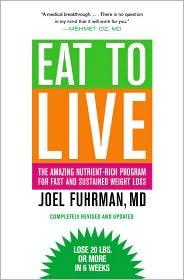
Joel Fuhrman, a family physician specializing in nutritional medicine, built Eat to Live around a single equation: Health equals nutrients divided by calories, or H = N/C. The argument is that most Americans are simultaneously overfed and undernourished — consuming enormous quantities of calories from nutrient-poor processed foods and animal products while starving their cells of the micronutrients, antioxidants, and phytochemicals found in vegetables, fruits, beans, and nuts. The result, Fuhrman argues, is not just obesity but a comprehensive epidemic of preventable chronic disease.
The book's central concept is nutrient density. Fuhrman introduces what he calls the ANDI scale — Aggregate Nutrient Density Index — which ranks foods by nutrients per calorie. Dark leafy greens score highest. Refined grains, sugar, cheese, and meat score lowest. The practical prescription flows from this: build your diet around what Fuhrman calls G-BOMBS (greens, beans, onions, mushrooms, berries, seeds), eat as much of these as you want, and drastically reduce or eliminate refined carbohydrates, dairy, meat, and added oils.
What it gets right
- 1.
Health equals Nutrients divided by Calories. Most people eat a diet high in calories and low in the micronutrients that cells actually need.
- 2.
Nutrient density — the concentration of vitamins, minerals, antioxidants, and phytochemicals per calorie — is a more useful framework than counting macronutrients or restricting fat.
- 3.
G-BOMBS (greens, beans, onions, mushrooms, berries, seeds) are the core of a disease-resistant diet. Fuhrman recommends eating them in large quantities daily.
What it covers
Who wrote it
Joel Fuhrman is an American family physician who has specialized in nutritional medicine since the early 1990s. He is the author of several follow-up books including Super Immunity, The End of Diabetes, and Fast Food Genocide. Fuhrman runs the Nutritional Research Foundation and maintains a clinical practice in New Jersey. His work draws on epidemiological studies, particularly the Nurses' Health Study and China-Cornell-Oxford Project, and on his own patient outcomes over three decades.
