Talk to Eat to Live like its author wrote you back.
Get the ideas that fit your life — not generic summaries.
- Chat with the book
- Audiobook-style main ideas
- Adapts to your life and goals
- Helps you take action
Eat to Live, in detail
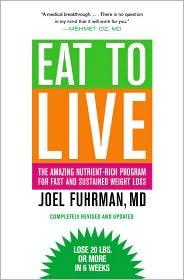
Joel Fuhrman, a family physician specializing in nutritional medicine, built Eat to Live around a single equation: Health equals nutrients divided by calories, or H = N/C. The argument is that most Americans are simultaneously overfed and undernourished — consuming enormous quantities of calories from nutrient-poor processed foods and animal products while starving their cells of the micronutrients, antioxidants, and phytochemicals found in vegetables, fruits, beans, and nuts. The result, Fuhrman argues, is not just obesity but a comprehensive epidemic of preventable chronic disease.
The book's central concept is nutrient density. Fuhrman introduces what he calls the ANDI scale — Aggregate Nutrient Density Index — which ranks foods by nutrients per calorie. Dark leafy greens score highest. Refined grains, sugar, cheese, and meat score lowest. The practical prescription flows from this: build your diet around what Fuhrman calls G-BOMBS (greens, beans, onions, mushrooms, berries, seeds), eat as much of these as you want, and drastically reduce or eliminate refined carbohydrates, dairy, meat, and added oils.
Fuhrman presents substantial clinical evidence that this approach produces dramatic weight loss, reversal of type 2 diabetes, reduction in blood pressure and cholesterol, and improvement in autoimmune conditions. His six-week plan is aggressive: near-vegan with no added salt, oil, or sugar. He distinguishes between the six-week jump-start and the long-term lifestyle, arguing that initial strict adherence recalibrates both physiology and taste preferences, making the diet easier to sustain after the reset period.
The book has aged reasonably well. The emphasis on micronutrient-rich plant foods, beans, and nuts has been supported by major cohort studies since its publication. Critics note that the complete exclusion of animal products and added oils is stricter than current evidence requires, and the ANDI scale is a proprietary measure with its own limitations. But the core message — that the density of nutrients relative to calories is a better frame for food choice than macronutrient ratios alone — remains a genuinely useful corrective to conventional diet advice.
The big ideas
- 1.
Health equals Nutrients divided by Calories. Most people eat a diet high in calories and low in the micronutrients that cells actually need.
- 2.
Nutrient density — the concentration of vitamins, minerals, antioxidants, and phytochemicals per calorie — is a more useful framework than counting macronutrients or restricting fat.
- 3.
G-BOMBS (greens, beans, onions, mushrooms, berries, seeds) are the core of a disease-resistant diet. Fuhrman recommends eating them in large quantities daily.
