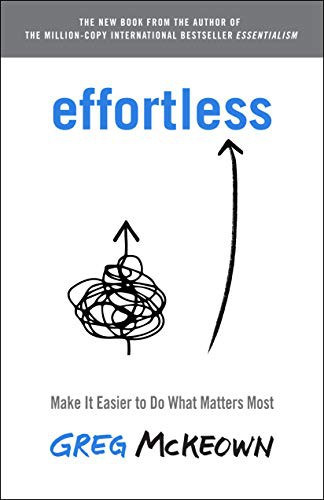
Talk to Effortless: Make It Easier to Do What Matters Most like its author wrote you back.
Get the ideas that fit your life — not generic summaries.
- Chat with the book
- Audiobook-style main ideas
- Adapts to your life and goals
- Helps you take action
What it argues
Effortless is McKeown's follow-up to Essentialism, and where that book asked which things matter, this one asks why the right things always feel so hard. McKeown's answer is that difficulty has been mistaken for virtue — that grinding through exhaustion is treated as proof of commitment rather than as a signal that something has gone wrong. His central claim is that the path of least resistance and the path of greatest importance can, and should, be made to overlap.
The book divides into three parts. The first is the Effortless State: clearing the mental and physical clutter — resentment, overthinking, fatigue — that makes effort feel heavier than it needs to be. The second is Effortless Action, which covers techniques for taking the simplest direct path: defining what "done" looks like before you start, pacing yourself to avoid burnout, and completing the most essential step rather than building elaborate systems around it. The third is Effortless Results, about designing for residual returns — how to set up processes, routines, and teaching so that effort invested once produces outputs repeatedly.
What it gets right
- 1.
The belief that important things must be hard is itself a trap. McKeown argues that making essential work easier is a legitimate and high-leverage strategy, not a shortcut.
- 2.
The Effortless State is a precondition for good work: resentment, overthinking, and chronic fatigue all act as drag on effort. Clearing them before starting is part of the work.
- 3.
Define 'done' before you begin. Without a clear finish line, tasks expand indefinitely and the feeling of completion never arrives.
What it covers
Who wrote it
Greg McKeown is a British-American author and leadership consultant best known for Essentialism (2014), which spent more than 200 weeks on the New York Times bestseller list. He speaks at organizations including Apple, Google, and the United Nations, and hosts the "What's Essential" podcast. McKeown studied at Stanford Graduate School of Business and has written for Harvard Business Review, The New York Times, and Fast Company. Effortless is his second major book and builds directly on the framework established in Essentialism.
