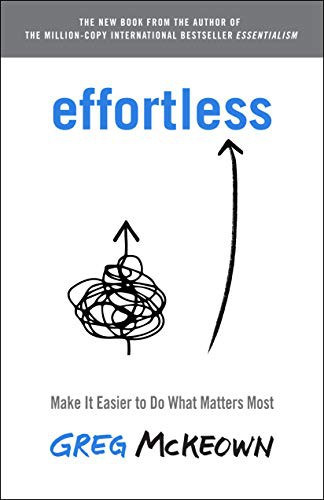
Effortless: Make It Easier to Do What Matters Most by Greg McKeown is a 2021 self-help book about simplicity, productivity, effort. The belief that important things must be hard is itself a trap. McKeown argues that making essential work easier is a legitimate and high-leverage strategy, not a shortcut.
Summary
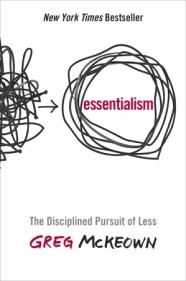
Effortless is McKeown's follow-up to Essentialism, and where that book asked which things matter, this one asks why the right things always feel so hard. McKeown's answer is that difficulty has been mistaken for virtue — that grinding through exhaustion is treated as proof of commitment rather than as a signal that something has gone wrong. His central claim is that the path of least resistance and the path of greatest importance can, and should, be made to overlap.
The book divides into three parts. The first is the Effortless State: clearing the mental and physical clutter — resentment, overthinking, fatigue — that makes effort feel heavier than it needs to be. The second is Effortless Action, which covers techniques for taking the simplest direct path: defining what "done" looks like before you start, pacing yourself to avoid burnout, and completing the most essential step rather than building elaborate systems around it. The third is Effortless Results, about designing for residual returns — how to set up processes, routines, and teaching so that effort invested once produces outputs repeatedly.
McKeown's argument is not that hard work is avoidable. It is that much of what passes for productive effort is unnecessary friction — unnecessary steps, unnecessary emotion, unnecessary complexity — and that removing it is itself a high-leverage skill. The book draws on cognitive science, Stoic practice, and case studies of people who seem to get outsized results with what looks like minimal strain. McKeown calls this finding the "easier path" rather than the "easy path" — the distinction being that it still requires care and intent.
Effortless is most useful for people who already know what matters in their lives but keep running out of steam before reaching it. The practical suggestions are concrete and short: invert the question from "how do I make this less difficult" to "what would this look like if it were easy?" The weakness is that the advice sometimes leans more toward mindset than mechanism, and readers looking for the systematic rigor of Atomic Habits or Deep Work may find it less structured. As a companion to Essentialism, though, it completes the argument usefully.
Talk to Effortless: Make It Easier to Do What Matters Most like its author wrote you back.
Get the ideas that fit your life — not generic summaries.
- Chat with the book
- Audiobook-style main ideas
- Adapts to your life and goals
- Helps you take action
Key takeaways
- 1.
The belief that important things must be hard is itself a trap. McKeown argues that making essential work easier is a legitimate and high-leverage strategy, not a shortcut.
- 2.
The Effortless State is a precondition for good work: resentment, overthinking, and chronic fatigue all act as drag on effort. Clearing them before starting is part of the work.
- 3.
Define 'done' before you begin. Without a clear finish line, tasks expand indefinitely and the feeling of completion never arrives.
- 4.
Pace matters more than intensity. McKeown argues for a sustainable upper limit on daily effort, drawing on research showing that elite performers rest as deliberately as they work.
- 5.
Effortless Action is not passive. It means finding the simplest path to the essential outcome — removing unnecessary steps rather than trying harder to push through them.
- 6.
Residual results compound like habits. Teaching someone a skill, writing something once that readers find repeatedly, building a system that runs without you — these are the highest-return uses of effort.
- 7.
Ask "what would this look like if it were easy?" before starting anything important. The question surfaces assumptions and unnecessary steps that most people never examine.
- 8.
Completing one small, real step beats elaborate planning. McKeown consistently favors action on the minimum viable next move over comprehensive preparation.
Discussion questions
Use these on your own, with a book club, or as chat starters in Superbook. Book club version, ready to copy or print →
- 1.
McKeown claims that conflating difficulty with virtue is a cultural problem, not a personal failing. Where in your own life have you made something harder than it needed to be as a form of proof?
- 2.
Which of the three parts — Effortless State, Effortless Action, or Effortless Results — describes the stage where you most often get stuck?
- 3.
Think of something important in your life that currently feels like a grind. What would it look like if it were easy? What steps would you cut?
- 4.
McKeown recommends setting a maximum effort limit per day, not just a minimum. What would a sustainable upper limit look like for your most demanding work?
- 5.
What resentment, unresolved conflict, or lingering worry is costing you the most mental energy right now? What would it take to clear it?
- 6.
Where are you currently optimizing for completion speed when you should be optimizing for not burning out before you finish?
- 7.
McKeown draws a distinction between the easy path and the easier path. What is one important project in your life where the easier path is available but you have been ignoring it?
- 8.
Residual results require upfront investment. What is one thing you could write, build, or teach once that would continue producing value without repeated effort?
- 9.
Define done for something you are currently working on. Is the finish line actually clear, or have you been moving it?
- 10.
McKeown suggests that rest is not the opposite of productivity but a precondition for it. How does your current weekly rhythm reflect that, or not?
- 11.
Essentialism is about what to focus on; Effortless is about how to do it sustainably. Which of the two problems is harder for you — choosing what matters, or actually executing on it without burning out?
- 12.
The book argues that teaching others multiplies your effort. Is there something you currently do manually that someone else could learn to do, either at work or at home?
Themes
Frequently asked questions
-
Is Effortless worth reading?
Yes, particularly if you have read Essentialism and want the practical counterpart. McKeown is good at reframing why you feel stuck, and the short chapters make it easy to act on one idea before reading the next. Readers looking for research-heavy arguments or detailed systems may find it lighter than they prefer.
-
How long does it take to read Effortless?
Around four hours at average reading pace. The chapters are short and punchy, typically five to eight pages each, which makes it well-suited to reading in short sessions with reflection in between.
-
What is the difference between Essentialism and Effortless?
Essentialism is about identifying what matters most and eliminating the rest. Effortless picks up where Essentialism leaves off, asking: once you know what matters, how do you make it less exhausting? The books are companion volumes rather than standalone works.
-
Who should read Effortless?
People who already have a sense of their priorities but feel chronically depleted trying to act on them. It is also useful for anyone who conflates effort with virtue — the belief that if something is not hard, it is not worth doing.
-
What is the most actionable idea in Effortless?
The "what would this look like if it were easy?" reframe. McKeown argues that asking this question before starting a task surfaces unnecessary steps and flawed assumptions that most people never question.