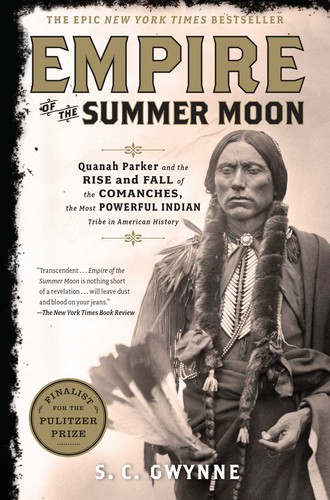
Talk to Empire of the Summer Moon: Quanah Parker and the Rise and Fall of the Comanches like its author wrote you back.
Get the ideas that fit your life — not generic summaries.
- Chat with the book
- Audiobook-style main ideas
- Adapts to your life and goals
- Helps you take action
What it argues
Empire of the Summer Moon, published in 2010, follows the rise of the Comanche empire on the southern Great Plains and the long, brutal conflict between the Comanches and the expanding United States. The organizing story is the life of Quanah Parker — the son of Comanche chief Peta Nocona and Cynthia Ann Parker, a white woman who had been captured as a child and raised Comanche — and his eventual leadership of the Quahadi band through the final years of resistance and the transition to reservation life. S. C. Gwynne, a journalist and former Time magazine editor, narrates with momentum and detail.
The book's first section documents the Comanches' transformation into the dominant military power of the Plains after acquiring horses in the seventeenth century. Gwynne argues that the Comanches were not simply a nomadic tribe living off the land but a genuine empire — controlling a territory larger than many European nations, extracting tribute, raiding thousands of miles in all directions, and holding off Spanish, Mexican, and American expansion for two centuries. The horse gave them a military advantage so profound that Texas, despite its ambitions, could not effectively colonize the interior until the mid-nineteenth century.
What it gets right
- 1.
The Comanches built a genuine empire on the southern Great Plains, holding off Spanish, Mexican, and American expansion for two centuries through mastery of mounted warfare.
- 2.
Horse culture transformed the Comanches from a marginal group into the most militarily powerful force in the interior Southwest — a transformation that happened within a few generations.
- 3.
The U.S. Army's final defeat of the Comanches came not primarily through pitched battles but through the destruction of their logistical base: winter camps, food stores, and especially horse herds.
What it covers
Who wrote it
S. C. Gwynne is an American journalist and author who spent many years as a writer and editor at Time magazine. He was raised in Texas and has written extensively on Texas and Western American history. His other books include Rebel Yell: The Violence, Passion, and Redemption of Stonewall Jackson. Empire of the Summer Moon was a finalist for the Pulitzer Prize in General Nonfiction in 2011. He lives in Austin, Texas.
