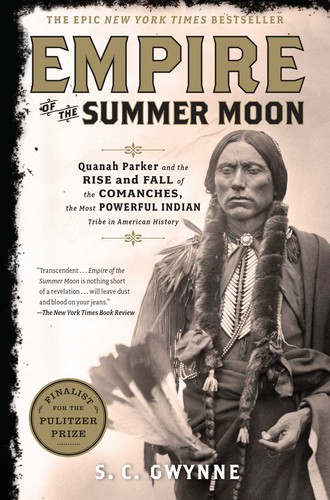
Empire of the Summer Moon: Quanah Parker and the Rise and Fall of the Comanches by S. C. Gwynne is a 2010 history book about conquest, indigenous history, american west. The Comanches built a genuine empire on the southern Great Plains, holding off Spanish, Mexican, and American expansion for two centuries through mastery of mounted warfare.
Summary
Empire of the Summer Moon, published in 2010, follows the rise of the Comanche empire on the southern Great Plains and the long, brutal conflict between the Comanches and the expanding United States. The organizing story is the life of Quanah Parker — the son of Comanche chief Peta Nocona and Cynthia Ann Parker, a white woman who had been captured as a child and raised Comanche — and his eventual leadership of the Quahadi band through the final years of resistance and the transition to reservation life. S. C. Gwynne, a journalist and former Time magazine editor, narrates with momentum and detail.
The book's first section documents the Comanches' transformation into the dominant military power of the Plains after acquiring horses in the seventeenth century. Gwynne argues that the Comanches were not simply a nomadic tribe living off the land but a genuine empire — controlling a territory larger than many European nations, extracting tribute, raiding thousands of miles in all directions, and holding off Spanish, Mexican, and American expansion for two centuries. The horse gave them a military advantage so profound that Texas, despite its ambitions, could not effectively colonize the interior until the mid-nineteenth century.
The second section covers the wars of extermination that ended Comanche power in the 1870s, particularly the Red River War and the campaign by Colonel Ranald Mackenzie that ultimately broke the Quahadi band not through direct battle but by destroying their winter camps and horse herds. Gwynne presents these events without sanitizing either side. The Comanche raiding culture involved real brutality; the U.S. Army's campaigns involved deliberate destruction of civilian populations. The collision of these two systems is described in tactical detail and without the comfortable narrative that one side was simply civilized.
Quanah Parker's life after the reservation is the book's final act and its most surprising. He became an effective political operator, negotiated with Washington on behalf of his people, grew wealthy leasing reservation land, and entertained Theodore Roosevelt. He refused to choose one identity over the other — Comanche chief and successful capitalist — and died as both in 1911. Gwynne uses his story to avoid a simple tragedy narrative, though the losses documented in the preceding chapters make optimism about what Quanah accomplished complicated.
Talk to Empire of the Summer Moon: Quanah Parker and the Rise and Fall of the Comanches like its author wrote you back.
Get the ideas that fit your life — not generic summaries.
- Chat with the book
- Audiobook-style main ideas
- Adapts to your life and goals
- Helps you take action
Key takeaways
- 1.
The Comanches built a genuine empire on the southern Great Plains, holding off Spanish, Mexican, and American expansion for two centuries through mastery of mounted warfare.
- 2.
Horse culture transformed the Comanches from a marginal group into the most militarily powerful force in the interior Southwest — a transformation that happened within a few generations.
- 3.
The U.S. Army's final defeat of the Comanches came not primarily through pitched battles but through the destruction of their logistical base: winter camps, food stores, and especially horse herds.
- 4.
The warfare on both sides was brutal, and the book does not present either the Comanche raiding culture or the U.S. campaigns as simply justified or simply monstrous.
- 5.
Cynthia Ann Parker's capture and recapture illustrates the difficulty of fixed identities in contact zones — she did not want to leave the Comanche life she had built, and her forced return to white Texas was experienced as a second abduction.
- 6.
Quanah Parker's post-reservation success came from adapting strategically to a changed world without entirely surrendering his Comanche identity — a model that was unusual among reservation leaders.
- 7.
The Texas frontier experience created a culture of extreme violence and self-reliance that shaped Texas identity and politics for generations.
- 8.
The end of the Comanche empire was not inevitable — it required specific military innovations, federal commitment, and the near-extermination of the buffalo that sustained the Plains economy.
Discussion questions
Use these on your own, with a book club, or as chat starters in Superbook. Book club version, ready to copy or print →
- 1.
Gwynne calls the Comanches an empire. What does that framing do politically, and do you find it accurate?
- 2.
The book describes Comanche raiding culture in detail, including its brutality. How does that context affect the way you read the U.S. military campaigns against them?
- 3.
Cynthia Ann Parker did not want to be 'rescued.' What does her story reveal about whose categories of freedom and captivity were being applied?
- 4.
Gwynne argues the Comanches held off expansion for two centuries largely because of their military superiority. What finally broke that superiority?
- 5.
The destruction of the buffalo herds was essential to defeating the Comanches. Was that a military tactic, an economic calculation, or something else?
- 6.
Quanah Parker became successful by operating within the reservation system. Is that a form of resistance, accommodation, or something that resists that binary?
- 7.
The book is focused on military and political history and less on Comanche daily life, religion, or non-military culture. What does that emphasis miss?
- 8.
Gwynne is a journalist writing narrative history. How does that genre affect what he can claim and how he handles uncertainty?
- 9.
The Texas Ranger campaigns are presented as both brutal and effective. What is Gwynne's moral position on that effectiveness?
- 10.
The book ends with Quanah Parker's death in 1911. What happened to the Comanche Nation after that point, and does the book give you enough context to think about it?
- 11.
How does the Comanche story compare to the histories of other Plains peoples you know?
- 12.
Gwynne writes about this history with evident admiration for the Comanches as warriors. Does admiration for military skill translate into adequate historical respect?
Themes
Frequently asked questions
-
Is Empire of the Summer Moon historically accurate?
Mostly yes, though some historians have challenged details and note that Gwynne relies heavily on older secondary sources and does not fully incorporate recent Comanche scholarship. The broad outlines — the military power, the wars, Quanah Parker's biography — are well-documented.
-
Who should read Empire of the Summer Moon?
Anyone interested in American Western history, in the mechanics of empire and conquest, or in the specific history of Texas and the southern Plains. It reads quickly and accessibly for a book covering a complex period.
-
How long is the book?
Around seven to eight hours at average reading pace. It is longer than it feels — the narrative pacing keeps it moving.
-
Is the book sympathetic to the Comanches?
Gwynne clearly admires the Comanches as a military force and treats their defeat as a genuine loss. Whether that constitutes sympathy in a deeper sense — addressing their perspective, their cosmology, their losses beyond the battlefield — is more debatable.
-
What happened to Quanah Parker's descendants?
The Parker family remained prominent in Comanche and Oklahoma history. Several descendants have been active in tribal governance and in preserving Comanche culture. Quanah Parker is a central figure in Comanche historical identity today.
Similar books
Bury My Heart at Wounded Knee: An Indian History of the American West
Dee Brown

Guns, Germs, and Steel
Jared Diamond
Sapiens: A Brief History of Humankind
Yuval Noah Harari

Long Walk to Freedom
Nelson Mandela
