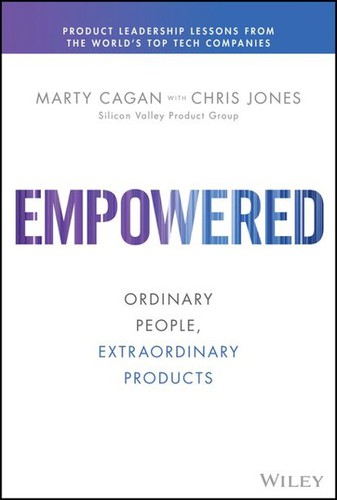
Talk to Empowered: Ordinary People, Extraordinary Products like its author wrote you back.
Get the ideas that fit your life — not generic summaries.
- Chat with the book
- Audiobook-style main ideas
- Adapts to your life and goals
- Helps you take action
What it argues
Empowered is Marty Cagan and Chris Jones's guide to what separates product organizations that consistently build products people love from those that operate as feature factories. Where Inspired focused on what strong product teams do, Empowered focuses on what product leaders need to do to create the conditions for those teams to thrive. The central argument is that the biggest obstacle to great products is not talented people — it is the way those people are managed and organized.
Cagan's diagnosis is that most product organizations are structured as delivery machines rather than discovery engines. They receive requirements from stakeholders, convert them into roadmap items, and measure success by whether features shipped on time — not by whether those features solved the customer's problem or moved a business metric. This delivery model fails not because the people are bad but because the incentive structure, the information flow, and the accountability structure all reward output rather than outcome.
What it gets right
- 1.
The feature factory model — giving teams lists of features to build and measuring output — is the most common source of wasted engineering capacity and poor product outcomes.
- 2.
Empowered product teams are given problems to solve and outcomes to achieve, not solutions to implement. The distinction between being given a problem and being given a solution determines how teams are managed and whether they can innovate.
- 3.
Product managers must deeply understand four things: their customers, their business context, their technology, and their market. A PM who lacks depth in any one of these will make poor tradeoffs.
What it covers
Who wrote it
Marty Cagan is the founder of the Silicon Valley Product Group and the author of Inspired, which preceded Empowered. He spent his early career as a senior product leader at eBay and Hewlett-Packard. Chris Jones is a coach and partner at SVPG who has led product and engineering teams at companies including Amplitude. Empowered, published in 2020, was written specifically to address the leadership layer that Inspired left largely unaddressed — how product leaders create the conditions that allow strong product teams to do their best work.
