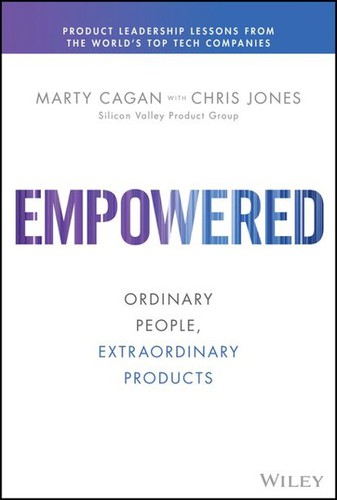
Empowered: Ordinary People, Extraordinary Products by Marty Cagan and Chris Jones is a 2020 business book about product management, leadership, organizational design. The feature factory model — giving teams lists of features to build and measuring output — is the most common source of wasted engineering capacity and poor product outcomes.
Summary
Empowered is Marty Cagan and Chris Jones's guide to what separates product organizations that consistently build products people love from those that operate as feature factories. Where Inspired focused on what strong product teams do, Empowered focuses on what product leaders need to do to create the conditions for those teams to thrive. The central argument is that the biggest obstacle to great products is not talented people — it is the way those people are managed and organized.
Cagan's diagnosis is that most product organizations are structured as delivery machines rather than discovery engines. They receive requirements from stakeholders, convert them into roadmap items, and measure success by whether features shipped on time — not by whether those features solved the customer's problem or moved a business metric. This delivery model fails not because the people are bad but because the incentive structure, the information flow, and the accountability structure all reward output rather than outcome.
The empowered product team model requires three things from product leadership. First, real empowerment: teams are given a specific problem to solve — an outcome to achieve — and the authority to discover the best solution. They are not given a list of features to build. Second, the right people: a product manager who deeply understands the customer, the business, and the technology; a designer who is a first-class partner; and engineers who are engaged in discovery, not just delivery. Third, coaching: the product manager role is one of the most difficult in a technology organization, and it requires specific investment from leadership to develop the judgment the role requires.
Empowered also addresses how to set strategy that connects company strategy to team-level OKRs in a way that gives teams genuine direction without micromanaging their methods. The OKR chapter is the most practically detailed in the book. Cagan is critical of how most organizations implement OKRs — as a top-down mandate list — and offers an alternative that ties team objectives to specific business outcomes the teams are accountable for.
Talk to Empowered: Ordinary People, Extraordinary Products like its author wrote you back.
Get the ideas that fit your life — not generic summaries.
- Chat with the book
- Audiobook-style main ideas
- Adapts to your life and goals
- Helps you take action
Key takeaways
- 1.
The feature factory model — giving teams lists of features to build and measuring output — is the most common source of wasted engineering capacity and poor product outcomes.
- 2.
Empowered product teams are given problems to solve and outcomes to achieve, not solutions to implement. The distinction between being given a problem and being given a solution determines how teams are managed and whether they can innovate.
- 3.
Product managers must deeply understand four things: their customers, their business context, their technology, and their market. A PM who lacks depth in any one of these will make poor tradeoffs.
- 4.
Coaching is the most important leadership practice in product organizations. Developing PM judgment cannot be outsourced to training courses — it requires ongoing 1:1 investment from experienced product leaders.
- 5.
OKRs work when they are genuinely bottom-up at the team level: teams propose their objectives based on the strategy and negotiate with leadership for alignment. OKRs fail when they are top-down mandates that teams are held accountable for executing.
- 6.
The product strategy layer — between company strategy and team OKRs — is where most organizations fail. Without a clear product strategy that allocates focus across the portfolio, teams optimize locally and produce organizational incoherence.
- 7.
Topgrading for product: every leadership position in a product organization should be filled with someone who has demonstrated the ability to do the job at the next level of complexity, not someone who has mastered the current level.
- 8.
The three levels of product work: product vision (where are we going?), product strategy (how are we getting there?), and product discovery (what is the right solution for this specific problem?). Most organizations conflate all three and get none right.
Discussion questions
Use these on your own, with a book club, or as chat starters in Superbook. Book club version, ready to copy or print →
- 1.
Cagan says most product organizations are feature factories. What are the organizational conditions that create a feature factory, and what does it take to change them?
- 2.
What is the difference between giving a team a problem to solve and giving them a solution to implement? Have you seen both, and what was the difference in outcomes?
- 3.
Product managers require deep knowledge of customers, business, technology, and market. Which of these four is hardest to develop, and what investment is required to develop it?
- 4.
Cagan is critical of top-down OKR processes. What goes wrong when OKRs are mandated rather than negotiated? Have you seen effective OKR implementations?
- 5.
The product strategy layer is where Cagan says most organizations fail. What makes it hard to create a product strategy that is specific enough to guide teams but flexible enough to allow discovery?
- 6.
Empowered requires a different kind of product leader than the feature factory. What experiences and capabilities distinguish a leader who can run an empowered organization from one who can only run a delivery-focused one?
- 7.
How does the empowered team model interact with the governance and accountability structures that most large organizations require?
- 8.
Cagan argues that designers should be first-class partners, not service providers. What changes in how design is structured, resourced, and evaluated if you treat it that way?
- 9.
The book is explicit that empowered product teams are not appropriate for all companies — organizations that are executing a well-understood playbook at scale may not need them. When is a delivery model actually the right model?
- 10.
How do you measure whether a product organization is empowered or a feature factory? What observable signals would you look for in a thirty-minute audit?
- 11.
Empowered focuses on technology product teams. How much of the framework applies to product development in non-technology companies?
Themes
Frequently asked questions
-
Should I read Inspired before Empowered?
Empowered is most valuable if you've read Inspired first. Inspired establishes the framework for what strong product teams do; Empowered explains what leaders need to do to create those teams. Reading them in order gives you the complete picture.
-
Who is Empowered written for?
Product managers, heads of product, CPOs, and engineering leaders who manage or aspire to manage product teams. It is more useful for senior practitioners than for individual contributors.
-
What is the key difference between a feature factory and an empowered product organization?
A feature factory gives teams solutions to implement and measures them on delivery. An empowered product organization gives teams problems to solve and outcomes to achieve, and measures them on whether those outcomes were accomplished. The difference determines whether teams can innovate or are restricted to executing.
-
How do you implement OKRs the way Cagan recommends?
Teams propose their own OKRs based on the company and product strategy, then align with leadership to ensure coherence. Leadership provides strategic direction and constraints; teams design their own path to the objectives. The CEO's OKRs cascade into the company strategy, which cascades into product strategy, which frames the space in which teams propose their OKRs.
-
What is the product strategy layer?
The layer between company strategy and team-level OKRs that determines which customer problems and market opportunities to prioritize across the product portfolio. Most organizations skip it, causing teams to optimize locally and produce organizational incoherence in the product.
Similar books
Inspired: How to Create Tech Products Customers Love
Marty Cagan
Continuous Discovery Habits
Teresa Torres
Measure What Matters
John Doerr
Creativity, Inc.: Overcoming the Unseen Forces That Stand in the Way of True Inspiration
Ed Catmull and Amy Wallace
