Talk to Enlightenment Now like its author wrote you back.
Get the ideas that fit your life — not generic summaries.
- Chat with the book
- Audiobook-style main ideas
- Adapts to your life and goals
- Helps you take action
What it argues
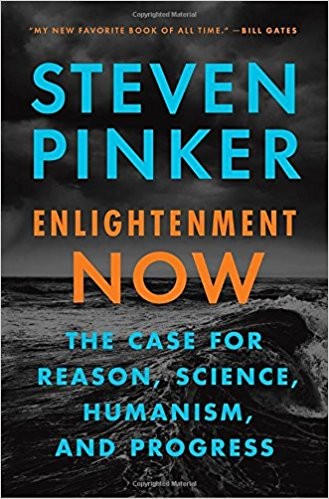
Enlightenment Now is Steven Pinker's argument that the ideals of the Enlightenment — reason, science, humanism, and progress — have been responsible for a dramatic and continuing improvement in human wellbeing across virtually every measurable dimension, and that these ideals are under threat from counter-Enlightenment movements on both the left and the right. The book is partly a data presentation, partly a philosophical argument, and partly a polemic defending liberal modernity against its critics.
The data section is the book's most substantial contribution. Pinker covers seventy-five metrics of human wellbeing — life expectancy, child mortality, poverty rates, caloric intake, literacy, hours of work, safety from violence, political freedom, gender equality, happiness — and shows that most have improved substantially over the past two centuries, and particularly in the past few decades. The improvements are not evenly distributed and some metrics move in more complex patterns, but the overall direction is strongly positive. Pinker argues this is not coincidental: it is the result of the application of reason, science, and trade to human problems.
What it gets right
- 1.
Most measurable dimensions of human wellbeing — life expectancy, poverty, violence, literacy, caloric sufficiency, political freedom — have improved substantially over two centuries and particularly since 1950.
- 2.
The Enlightenment's core commitments — applying reason and evidence to human problems, treating wellbeing rather than tradition or glory as the criterion of good outcomes — are the best explanation for those improvements.
- 3.
Progress is not automatic or guaranteed: it requires institutions, norms, and political will. Undermining those institutions, as populist and authoritarian movements do, puts progress at risk.
What it covers
Who wrote it
Steven Pinker is the Johnstone Family Professor of Psychology at Harvard University. His research focuses on language, cognition, and the evolution of the mind. His books include The Language Instinct, How the Mind Works, The Blank Slate, The Better Angels of Our Nature, and Rationality. He has twice been named one of Time magazine's 100 Most Influential People and one of Foreign Policy's 100 Global Thinkers. Enlightenment Now was praised by Bill Gates as his favorite book and became a New York Times bestseller.
