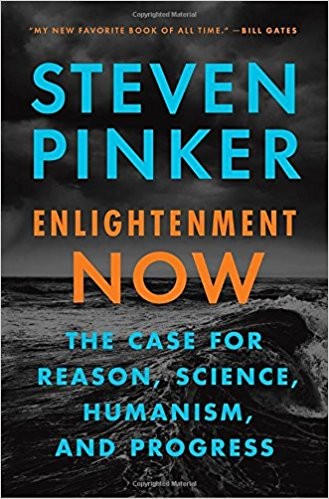
Enlightenment Now by Steven Pinker is a 2018 science book about progress, reason, humanism. Most measurable dimensions of human wellbeing — life expectancy, poverty, violence, literacy, caloric sufficiency, political freedom — have improved substantially over two centuries and particularly since 1950.
Summary
Enlightenment Now is Steven Pinker's argument that the ideals of the Enlightenment — reason, science, humanism, and progress — have been responsible for a dramatic and continuing improvement in human wellbeing across virtually every measurable dimension, and that these ideals are under threat from counter-Enlightenment movements on both the left and the right. The book is partly a data presentation, partly a philosophical argument, and partly a polemic defending liberal modernity against its critics.
The data section is the book's most substantial contribution. Pinker covers seventy-five metrics of human wellbeing — life expectancy, child mortality, poverty rates, caloric intake, literacy, hours of work, safety from violence, political freedom, gender equality, happiness — and shows that most have improved substantially over the past two centuries, and particularly in the past few decades. The improvements are not evenly distributed and some metrics move in more complex patterns, but the overall direction is strongly positive. Pinker argues this is not coincidental: it is the result of the application of reason, science, and trade to human problems.
The philosophical section argues for the values underlying progress: life over death, health over disease, knowledge over ignorance, freedom over coercion, wellbeing over suffering. Pinker presents these as the values that Enlightenment thinking both articulated and implemented, in contrast to counter-Enlightenment values: religious authority, romantic nationalism, utopian radicalism, and the glorification of heroic struggle. He sees resurgent authoritarianism, religious fundamentalism, anti-science movements, and both left and right populism as threats to the institutions and norms that make progress possible.
Critics have argued that Pinker is selective in his data, too quick to credit the Enlightenment specifically for progress that had multiple causes, and too complacent about the challenges that continue and those that lie ahead — particularly climate change, nuclear risk, and the concentration of economic and political power. The book is most persuasive as a corrective to apocalypticism and as a survey of actual progress; it is least persuasive as a causal story about what produced that progress.
Talk to Enlightenment Now like its author wrote you back.
Get the ideas that fit your life — not generic summaries.
- Chat with the book
- Audiobook-style main ideas
- Adapts to your life and goals
- Helps you take action
Key takeaways
- 1.
Most measurable dimensions of human wellbeing — life expectancy, poverty, violence, literacy, caloric sufficiency, political freedom — have improved substantially over two centuries and particularly since 1950.
- 2.
The Enlightenment's core commitments — applying reason and evidence to human problems, treating wellbeing rather than tradition or glory as the criterion of good outcomes — are the best explanation for those improvements.
- 3.
Progress is not automatic or guaranteed: it requires institutions, norms, and political will. Undermining those institutions, as populist and authoritarian movements do, puts progress at risk.
- 4.
Cognitive biases distort perceptions of progress: the availability heuristic makes vivid current disasters more psychologically present than diffuse gradual improvements; negativity bias causes bad news to register more powerfully than good.
- 5.
Climate change is a genuine and serious problem, but the response should be based on rational cost-benefit analysis and technological solutions rather than apocalypticism or degrowth ideology.
- 6.
Nuclear weapons are the most acute existential risk in Pinker's assessment, and the fact that they have not been used since 1945 is an important case study in how rational deterrence and deliberate institutional design can reduce catastrophic risk.
- 7.
The data show consistent progress on gender equality, reduction of extreme poverty, decline in absolute poverty, and expanded educational opportunity — though progress is uneven and not finished.
- 8.
Scientific literacy — understanding how evidence and reasoning work — is as important a civic good as literacy itself, and declining trust in expertise is a genuine threat to collective problem-solving.
Discussion questions
Use these on your own, with a book club, or as chat starters in Superbook. Book club version, ready to copy or print →
- 1.
Pinker argues most people wrongly believe the world is getting worse. Was your intuition corrected by the data in the book, or did you already hold the view he's defending?
- 2.
He credits the Enlightenment specifically for modern progress. How do you evaluate that causal attribution? What else might deserve credit?
- 3.
Some critics argue Pinker's optimism is too comfortable — that it underweights the people and places left behind by progress. Is that criticism fair?
- 4.
The availability heuristic leads people to overweight vivid recent disasters. Does identifying that bias change how you respond to news about the world?
- 5.
Pinker is critical of both left and right versions of counter-Enlightenment thinking. Do you think he treats both sides equally?
- 6.
He presents climate change as a serious but solvable problem. Does that framing seem appropriate to you given current trajectories?
- 7.
How much weight should the benefits of the global order — poverty reduction, peace, trade — receive against its costs — inequality, environmental damage, cultural homogenization?
- 8.
Which metric of progress did you find most surprising or most moving?
- 9.
Pinker explicitly defends liberal democracy and its institutions. Is that defense politically neutral or does it position the book ideologically?
- 10.
He argues that negativity bias explains why people feel things are getting worse even when they're not. How do you personally manage that bias in your reading of the news?
- 11.
What's missing from the data section — a metric of human wellbeing that you think is important but is not well captured in the book?
- 12.
Is the Enlightenment worldview — reason, science, humanism, progress — sufficient to address the challenges of the next century, or does it need to be supplemented or revised?
Themes
Frequently asked questions
-
Is Enlightenment Now just a defense of the status quo?
It is a defense of the values and institutions that Pinker credits with producing modern progress, but he acknowledges that those institutions are imperfect and that progress is incomplete. Critics argue the defense is too complacent about remaining inequalities and concentrated power. Pinker would say that's the wrong lesson to draw from genuinely good data.
-
Does the book address climate change?
Yes, at length. Pinker argues climate change is a serious problem but that apocalyptic framings are counterproductive. He favors technological solutions — nuclear, carbon capture, renewables — and argues that the institutions and norms of the Enlightenment are the appropriate tools for addressing it.
-
How does it relate to The Better Angels of Our Nature?
The Better Angels focuses specifically on the decline of violence. Enlightenment Now takes that argument as one data series among many, broadening to all dimensions of wellbeing and situating them in a philosophical defense of Enlightenment values.
-
What is the main criticism of the book?
That it is selective, glosses over distributional questions (who benefits, who doesn't), credits Enlightenment specifically for progress with multiple causes, and is insufficiently alarmed about existential risks and inequality. John Gray wrote the most sustained critique.
-
Is it too long?
It is long, and sections of the data chapters are repetitive. Readers primarily interested in the philosophical argument can skim the individual metric chapters. The opening and closing sections, which state the argument and respond to critics, are the most essential.
Similar books
The Better Angels of Our Nature
Steven Pinker

Sapiens: A Brief History of Humankind
Yuval Noah Harari
Homo Deus: A Brief History of Tomorrow
Yuval Noah Harari

The Second Machine Age
Erik Brynjolfsson and Andrew McAfee
