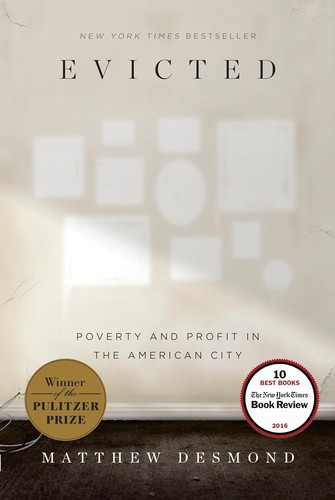
Talk to Evicted: Poverty and Profit in the American City like its author wrote you back.
Get the ideas that fit your life — not generic summaries.
- Chat with the book
- Audiobook-style main ideas
- Adapts to your life and goals
- Helps you take action
What it argues
Evicted is Matthew Desmond's account of eight Milwaukee families — tenants and landlords — living through the American housing crisis at its most basic level: the cycle of eviction. Desmond, a sociologist, embedded himself in a trailer park on the south side and a rooming house on the north side for more than a year, then spent several more years following up and verifying. The result is a book that shows, in granular human detail, how eviction is not just a consequence of poverty but one of its primary drivers.
The mechanism Desmond documents is a trap. When a family is evicted, they lose their housing history. Without a clean record, they can only rent in the cheapest, most degraded units from landlords who specialize in high-turnover, low-maintenance housing. Those landlords earn significant profits — sometimes better than higher-end properties — precisely because the tenants have nowhere else to go. The housing voucher system, designed to help, often fails because landlords won't accept vouchers or because evictions happen before vouchers arrive.
What it gets right
- 1.
Eviction is not just a symptom of poverty — it causes poverty. Losing housing destabilizes employment, schooling, health, and social networks in ways that take years to recover from.
- 2.
The worst housing in American cities generates some of the highest profit margins, because tenants with nowhere else to go cannot bargain and are not worth maintaining for.
- 3.
African American women are disproportionately likely to be evicted — in Milwaukee, they make up under ten percent of the population but thirty percent of evictions.
What it covers
Who wrote it
Matthew Desmond is a sociologist and professor at Princeton University, where he directs the Eviction Lab, a research center that tracks eviction data across the United States. Evicted, published in 2016, won the Pulitzer Prize for General Nonfiction, the National Book Critics Circle Award, and the Carnegie Medal. He followed it with Poverty, by America in 2023, a more explicitly polemical argument about how affluent Americans benefit from poverty. His research has directly influenced housing policy debates at the federal and state levels.
