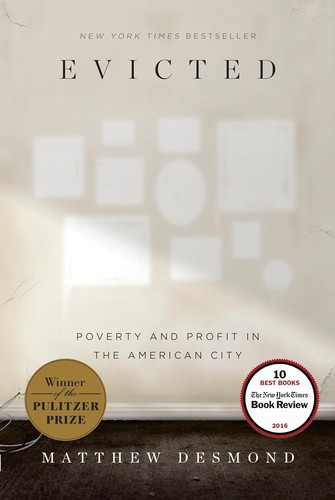
Evicted: Poverty and Profit in the American City by Matthew Desmond is a 2016 history book about housing, poverty, inequality. Eviction is not just a symptom of poverty — it causes poverty. Losing housing destabilizes employment, schooling, health, and social networks in ways that take years to recover from.
Summary
Evicted is Matthew Desmond's account of eight Milwaukee families — tenants and landlords — living through the American housing crisis at its most basic level: the cycle of eviction. Desmond, a sociologist, embedded himself in a trailer park on the south side and a rooming house on the north side for more than a year, then spent several more years following up and verifying. The result is a book that shows, in granular human detail, how eviction is not just a consequence of poverty but one of its primary drivers.
The mechanism Desmond documents is a trap. When a family is evicted, they lose their housing history. Without a clean record, they can only rent in the cheapest, most degraded units from landlords who specialize in high-turnover, low-maintenance housing. Those landlords earn significant profits — sometimes better than higher-end properties — precisely because the tenants have nowhere else to go. The housing voucher system, designed to help, often fails because landlords won't accept vouchers or because evictions happen before vouchers arrive.
The policy implication Desmond builds toward is a universal housing voucher, a guaranteed subsidy that would ensure no American family spends more than thirty percent of income on rent. He argues that housing instability has downstream costs — in child welfare, public health, employment, crime — that far exceed what a voucher program would cost. The epilogue makes this case explicitly; the narrative keeps it mostly implicit, which is the right choice.
Desmond won the Pulitzer Prize for this book, and its success lies in refusing to be a policy argument in disguise as a story. The families he follows — Arleen and her two sons, Scott the nurse who became addicted to pain medication, Lamar who lost his legs to frostbite — are drawn with the complexity of people rather than the flatness of case studies. The landlords too are not villains in a simple sense: Sherrena, who owns dozens of units on the north side, operates within a system she did not design and exploits it rationally. That refusal to simplify is what makes the book's indictment of the system so hard to dismiss.
Talk to Evicted: Poverty and Profit in the American City like its author wrote you back.
Get the ideas that fit your life — not generic summaries.
- Chat with the book
- Audiobook-style main ideas
- Adapts to your life and goals
- Helps you take action
Key takeaways
- 1.
Eviction is not just a symptom of poverty — it causes poverty. Losing housing destabilizes employment, schooling, health, and social networks in ways that take years to recover from.
- 2.
The worst housing in American cities generates some of the highest profit margins, because tenants with nowhere else to go cannot bargain and are not worth maintaining for.
- 3.
African American women are disproportionately likely to be evicted — in Milwaukee, they make up under ten percent of the population but thirty percent of evictions.
- 4.
The housing voucher system fails many people it's meant to help, partly because evictions happen faster than vouchers arrive and partly because landlords discriminate against voucher holders.
- 5.
Eviction creates a record that follows families, closing them out of better housing and forcing them into the informal or degraded end of the market — a trap that is hard to escape.
- 6.
Children bear a significant and measurable cost of housing instability: frequent moves mean frequent school changes, and evicted families often end up in worse neighborhoods than where they started.
- 7.
A universal housing voucher guaranteeing that no family spends more than thirty percent of income on rent would cost roughly the same as the mortgage interest deduction that primarily benefits the affluent.
- 8.
The market for low-income housing operates on a logic of extraction rather than service: high turnover, low maintenance, and the capture of government subsidies without improving conditions.
Discussion questions
Use these on your own, with a book club, or as chat starters in Superbook. Book club version, ready to copy or print →
- 1.
Desmond argues that eviction causes poverty as much as poverty causes eviction. Does the evidence in the book convince you? What would falsify that claim?
- 2.
Sherrena the landlord is one of the more complex figures in the book. How do you understand her relationship to the system she profits from?
- 3.
The housing voucher program is meant to help but often doesn't. What would make a housing subsidy actually work, and why hasn't it been reformed?
- 4.
Many of the families in the book make choices that seem self-defeating — spending on extras while behind on rent. How do you understand those choices in context?
- 5.
Desmond embedded himself in a trailer park and a rooming house. What does that method make possible, and what are its limits?
- 6.
The book notes that the mortgage interest deduction costs the government more than the entire housing assistance budget. What does that comparison tell you about political priorities around housing?
- 7.
Which family in the book stayed with you most after you finished? What do you think happened to them after the reporting ended?
- 8.
Desmond's prescription is a universal housing voucher. Is that a realistic political goal? What would the opposition look like, and would it be correct?
- 9.
How much of what happens in the book is specific to Milwaukee, and how much applies to your city?
- 10.
The book shows landlords making significant profits from the worst housing. Is that a market failure, or is it the market working as designed?
- 11.
Arleen makes decisions throughout the book that the reader might judge harshly. Does Desmond ask us to suspend that judgment? Should he?
- 12.
Desmond is a Harvard-educated sociologist who spent a year in a trailer park. How does that asymmetry of position affect what he could and couldn't see?
Themes
Frequently asked questions
-
What is Evicted about?
It follows eight Milwaukee families — tenants and landlords — through the cycle of eviction, showing how losing housing drives poverty rather than simply resulting from it. Desmond spent more than a year embedded in the communities he reports on.
-
Is Evicted nonfiction?
Yes, it is reported nonfiction. Desmond spent over a year in Milwaukee rooming houses and trailer parks, then spent several additional years verifying events, reviewing court records, and following up with subjects.
-
Is Evicted worth reading?
Yes. It is one of the most carefully reported books on American poverty in recent decades. The human detail is extraordinary, and the policy argument that emerges from the narrative is hard to dismiss because it earns its conclusions in specific lives rather than asserting them.
-
What is Desmond's solution to eviction?
He argues for a universal housing voucher guaranteeing that no American family spends more than thirty percent of their income on rent. He calculates this would cost roughly what the mortgage interest deduction — which primarily benefits wealthier homeowners — already costs.
-
How long is Evicted?
Around 430 pages, including appendices on Desmond's research methods. At average reading pace, expect about six hours. The narrative moves quickly for a work of social science.
Similar books
Caste: The Origins of Our Discontents
Isabel Wilkerson
The New Jim Crow: Mass Incarceration in the Age of Colorblindness
Michelle Alexander
Between the World and Me
Ta-Nehisi Coates

The Warmth of Other Suns
Isabel Wilkerson
