Talk to Exercised like its author wrote you back.
Get the ideas that fit your life — not generic summaries.
- Chat with the book
- Audiobook-style main ideas
- Adapts to your life and goals
- Helps you take action
Exercised, in detail
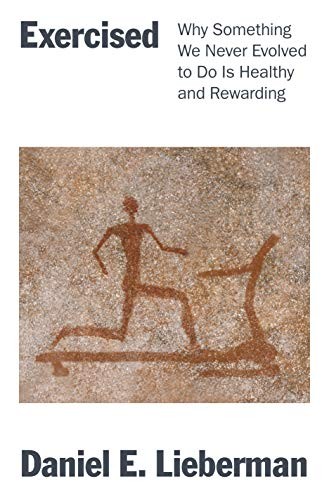
Exercised is Daniel Lieberman's follow-up to The Story of the Human Body, applying the same evolutionary lens specifically to physical activity — what it is, why we resist it, and which kinds produce which benefits. Lieberman's core provocation is that the common instruction to "exercise more" fundamentally misunderstands human biology: humans didn't evolve to exercise. We evolved to be physically active when necessary and to rest when possible, and that instinct — which served our ancestors well — now collides with environments where necessary activity has been engineered away.
The book opens by dismantling several widespread myths about exercise. Humans are not naturally lazy — they are rationally energy-conserving, which is different. Our ancestors were not running marathons daily; they walked long distances, carried loads, dug, climbed, and occasionally sprinted but also rested extensively between demands. Elite performance sports are a cultural invention of the last century or two; the human body was not designed for them. And exercise as a discrete, deliberate, scheduled activity is historically novel — for most of human existence, "exercise" was inseparable from survival tasks.
The bulk of the book examines specific types and amounts of physical activity through the lens of what the evidence actually shows about health benefits. Lieberman evaluates walking, running, strength training, high-intensity training, team sports, and sitting, synthesizing the research on each with particular attention to common misunderstandings. He is consistently willing to complicate simple narratives: running is good, but extreme amounts may not be; strength training is underutilized as a health intervention; sitting is harmful but the solution is not standing desks (which produce their own problems) but frequent breaks.
The final section addresses the cultural and policy question of why knowing that exercise is beneficial doesn't make people do more of it, and what kinds of environmental and social interventions actually change behavior. Lieberman argues that individual motivation is the wrong frame for a population-level problem, and that making physical activity normative, social, and embedded in daily life — as it is in blue zone communities — is more effective than prescriptions to go to the gym. The book is rigorous, opinionated, and consistently more nuanced than most exercise books.
The big ideas
- 1.
Humans evolved to be active when necessary and to rest otherwise — the 'natural laziness' narrative is wrong; what we have is rational energy conservation, which served our ancestors but maladapts in modern environments.
- 2.
Hunter-gatherers were active — roughly eight to ten miles of walking per day — but also rested extensively between physical demands, suggesting that rest is not a failure of discipline but a feature of healthy physiology.
- 3.
Walking, even at moderate amounts, produces substantial health benefits and may be the physical activity best supported by human evolutionary history.
