Talk to Expert Political Judgment like its author wrote you back.
Get the ideas that fit your life — not generic summaries.
- Chat with the book
- Audiobook-style main ideas
- Adapts to your life and goals
- Helps you take action
What it argues
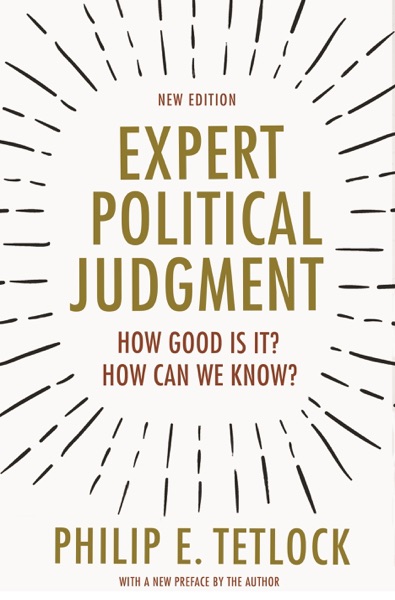
Expert Political Judgment is Philip Tetlock's report on a twenty-year study of political forecasters. Starting in 1984, Tetlock collected predictions from nearly three hundred experts — economists, political scientists, intelligence analysts, journalists — and then tracked whether those predictions came true. The results were damning: experts performed barely better than chance, and in many cases worse than simple statistical extrapolations or informed amateurs. The book is the primary source for the now-famous claim that political and economic experts are poor forecasters.
The study's most striking finding was not that experts were wrong, but that their accuracy depended heavily on how they thought rather than what they knew. Tetlock borrowed Isaiah Berlin's distinction between the fox and the hedgehog. Hedgehogs know one big thing: they have a single organizing theory — Marxism, market fundamentalism, realism — and they use it to explain almost everything. Foxes know many small things: they draw on multiple frameworks, update their views more readily, and are comfortable with uncertainty. In Tetlock's data, foxes outperformed hedgehogs in prediction, often substantially, especially over longer time horizons.
What it gets right
- 1.
Political and economic experts predict complex events only marginally better than chance over multi-year horizons. Domain knowledge alone does not produce calibrated forecasts.
- 2.
Foxes outperform hedgehogs. Forecasters who draw on multiple frameworks and update their beliefs readily are more accurate than those organized around a single explanatory theory.
- 3.
Hedgehogs are overconfident and resist updating even after clear failures. Their errors tend to be systematic, not random.
What it covers
Who wrote it
Philip Tetlock is a professor of psychology and management at the University of Pennsylvania's Wharton School and co-director of the Good Judgment Project. His research on political forecasting spans four decades. Expert Political Judgment, published in 2005, was followed by Superforecasting in 2015, a more accessible account of how the best forecasters actually think. Tetlock's work on epistemic accuracy has been influential in intelligence agencies, government policy circles, and behavioral economics, and he has received numerous awards for distinguished scientific contributions to psychology.
