Talk to Exponential Organizations like its author wrote you back.
Get the ideas that fit your life — not generic summaries.
- Chat with the book
- Audiobook-style main ideas
- Adapts to your life and goals
- Helps you take action
Exponential Organizations, in detail
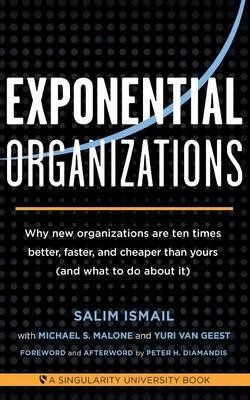
Exponential Organizations is Salim Ismail's framework for understanding why some companies — Airbnb, Uber, GitHub, Google — grew ten times faster than their peers and why traditional organizations struggle to match that pace. The central thesis is that the defining characteristic of an exponential organization is leveraging external resources — people, assets, information — rather than building everything internally. Instead of owning inventory, taxis, or hotel rooms, the fastest-growing companies access and orchestrate what already exists.
Ismail introduces the ExO framework built around a Massive Transformative Purpose (MTP) and ten attributes split into two groups: SCALE attributes (Staff on Demand, Community and Crowd, Algorithms, Leveraged Assets, Engagement) that tap external abundance, and IDEAS attributes (Interfaces, Dashboards, Experimentation, Autonomy, Social Technologies) that manage internal order. Companies don't need all ten, but the strongest ones combine several from each side. The framework is methodical and gives managers a diagnostic vocabulary even when its prescriptions don't translate cleanly to every context.
The book draws heavily on research from Singularity University, where Ismail served as a founding executive, and the Silicon Valley context is pervasive. The examples are strong — Quirky, TED, GitHub, Valve — and the pattern-matching across industries is genuinely illuminating. The argument that information-based disruption eventually reaches every industry, not just software, has held up better than skeptics predicted at publication.
Where the book strains is in the universality of its claims. The ExO attributes fit technology-adjacent companies very well and fit capital-intensive, regulated, or physical industries more awkwardly. Ismail acknowledges this but doesn't dwell on it. Readers in manufacturing, healthcare, or government will need to do significant translation work. Still, as a conceptual lens for understanding why certain organizations grow disproportionately fast, the framework is one of the more useful to emerge from the startup decade.
The big ideas
- 1.
Exponential organizations grow at least ten times faster than peers by accessing and leveraging external resources rather than building and owning everything internally.
- 2.
A Massive Transformative Purpose (MTP) — a bold, aspirational reason for existing — attracts talent, community, and partners without requiring direct compensation for all of them.
- 3.
Staff on Demand replaces permanent headcount with flexible access to expertise. This lowers fixed costs and increases adaptability when market conditions shift.
