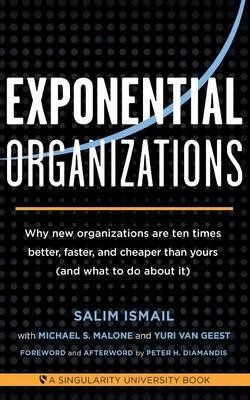
Exponential Organizations by Salim Ismail is a 2014 business book about organizational design, technology disruption, scaling. Exponential organizations grow at least ten times faster than peers by accessing and leveraging external resources rather than building and owning everything internally.
Summary
Exponential Organizations is Salim Ismail's framework for understanding why some companies — Airbnb, Uber, GitHub, Google — grew ten times faster than their peers and why traditional organizations struggle to match that pace. The central thesis is that the defining characteristic of an exponential organization is leveraging external resources — people, assets, information — rather than building everything internally. Instead of owning inventory, taxis, or hotel rooms, the fastest-growing companies access and orchestrate what already exists.
Ismail introduces the ExO framework built around a Massive Transformative Purpose (MTP) and ten attributes split into two groups: SCALE attributes (Staff on Demand, Community and Crowd, Algorithms, Leveraged Assets, Engagement) that tap external abundance, and IDEAS attributes (Interfaces, Dashboards, Experimentation, Autonomy, Social Technologies) that manage internal order. Companies don't need all ten, but the strongest ones combine several from each side. The framework is methodical and gives managers a diagnostic vocabulary even when its prescriptions don't translate cleanly to every context.
The book draws heavily on research from Singularity University, where Ismail served as a founding executive, and the Silicon Valley context is pervasive. The examples are strong — Quirky, TED, GitHub, Valve — and the pattern-matching across industries is genuinely illuminating. The argument that information-based disruption eventually reaches every industry, not just software, has held up better than skeptics predicted at publication.
Where the book strains is in the universality of its claims. The ExO attributes fit technology-adjacent companies very well and fit capital-intensive, regulated, or physical industries more awkwardly. Ismail acknowledges this but doesn't dwell on it. Readers in manufacturing, healthcare, or government will need to do significant translation work. Still, as a conceptual lens for understanding why certain organizations grow disproportionately fast, the framework is one of the more useful to emerge from the startup decade.
Talk to Exponential Organizations like its author wrote you back.
Get the ideas that fit your life — not generic summaries.
- Chat with the book
- Audiobook-style main ideas
- Adapts to your life and goals
- Helps you take action
Key takeaways
- 1.
Exponential organizations grow at least ten times faster than peers by accessing and leveraging external resources rather than building and owning everything internally.
- 2.
A Massive Transformative Purpose (MTP) — a bold, aspirational reason for existing — attracts talent, community, and partners without requiring direct compensation for all of them.
- 3.
Staff on Demand replaces permanent headcount with flexible access to expertise. This lowers fixed costs and increases adaptability when market conditions shift.
- 4.
Community and Crowd turns users, fans, and contributors into a productive asset. Wikipedia, GitHub, and open-source ecosystems all derive competitive value from this dynamic.
- 5.
Algorithms automate decisions that previously required human judgment at scale. The competitive advantage is in data quality and the feedback loops that improve the algorithm over time.
- 6.
Leveraged Assets means accessing rather than owning: Airbnb's real estate, Uber's vehicles, AWS's infrastructure. The business scales without proportional capital expenditure.
- 7.
Experimentation as a core attribute means running many small bets rather than a few large ones. Failure tolerance at small scale enables faster learning without catastrophic risk.
- 8.
Large incumbent organizations typically cannot become exponential without a separate, protected ExO initiative — the core business's immune system will attack anything that threatens existing revenue.
Discussion questions
Use these on your own, with a book club, or as chat starters in Superbook. Book club version, ready to copy or print →
- 1.
Which of the ten ExO attributes — SCALE or IDEAS — feels most foreign to how large organizations you know actually operate?
- 2.
Ismail argues every industry will eventually face information-based disruption. Is there an industry you believe is genuinely protected from this? Why?
- 3.
What would a Massive Transformative Purpose look like for an organization you're part of? Does one exist? Does it matter to people there?
- 4.
Staff on Demand reduces fixed costs but also reduces loyalty and institutional knowledge. How should an organization manage those tradeoffs?
- 5.
How does a large incumbent organization build an ExO initiative without its core business killing it? What structural protections are necessary?
- 6.
GitHub and Wikipedia derive enormous value from community contributors who are paid nothing. What motivates that behavior, and what undermines it?
- 7.
Ismail published this in 2014. Which of his examples have held up, and which have not?
- 8.
What does a Dashboard — real-time visibility into key metrics for everyone — require culturally to actually change behavior rather than just add reporting overhead?
- 9.
Autonomy is listed as an attribute, but it conflicts with traditional management hierarchies. How do companies you know handle that tension?
- 10.
The ExO framework was developed at Singularity University in Silicon Valley. Where does it apply poorly, and what does that reveal about its assumptions?
- 11.
What would have to change at an organization you know well for it to genuinely experiment — run many small bets, tolerate failures — rather than just claim to?
- 12.
Ismail argues community is more durable than marketing. Have you seen evidence of this? What destroys a community once it's built?
Themes
Frequently asked questions
-
Is Exponential Organizations worth reading?
Yes, especially for executives and founders trying to understand why some organizations scale so much faster than others. The framework is systematic enough to be applied rather than just admired. Readers in heavily regulated or physical industries should approach it with appropriate skepticism about universal applicability.
-
How long does it take to read Exponential Organizations?
Around five to six hours. The first half establishing the framework reads quickly; the case studies and implementation chapters in the second half are denser and reward slower reading if you're planning to apply the ideas.
-
What is the main idea of Exponential Organizations?
That the fastest-growing companies leverage external resources — people, assets, data — rather than building everything internally, and that this structural difference, not technology alone, explains their disproportionate growth.
-
Who should read Exponential Organizations?
Executives at established companies worried about disruption, founders designing organizations to scale, and strategists trying to understand how platform and network-effect businesses differ structurally from traditional firms.
-
What is a Massive Transformative Purpose and why does it matter?
An MTP is an aspirational statement of why an organization exists — beyond profit. Ismail argues that a compelling MTP attracts talent, community, and partners who work harder and more creatively than employees motivated purely by compensation. TED's 'Ideas worth spreading' is one of his examples.
Similar books

Blitzscaling: The Lightning-Fast Path to Building Massively Valuable Companies
Reid Hoffman and Chris Yeh
Zero to One: Notes on Startups, or How to Build the Future
Peter Thiel
The Lean Startup
Eric Ries
Platform Revolution
Geoffrey G. Parker, Marshall W. Van Alstyne, and Sangeet Paul Choudary
