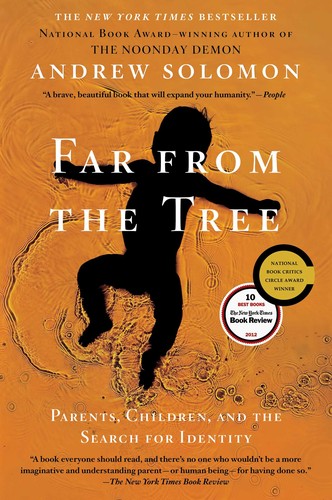
Talk to Far from the Tree: Parents, Children, and the Search for Identity like its author wrote you back.
Get the ideas that fit your life — not generic summaries.
- Chat with the book
- Audiobook-style main ideas
- Adapts to your life and goals
- Helps you take action
What it argues
Andrew Solomon's book is a ten-year investigation into families raising children who are profoundly different from their parents — deaf children of hearing parents, children with Down syndrome, autism, schizophrenia, severe physical disabilities, and other conditions that create what Solomon calls "horizontal identity": an identity shared with peers rather than inherited from family. The book also covers children who are prodigies, who were conceived in rape, and who become criminals. In each case Solomon asks the same question: how do parents and children find meaning in a profound mismatch of identity, and what does that process tell us about love?
Solomon distinguishes vertical identity, which is transmitted within a family — language, religion, ethnicity, values — from horizontal identity, which arrives in the child without parental precedent. Deaf parents of deaf children transmit an identity; hearing parents of deaf children must negotiate a gap that neither party chose. The book's central tension is between the medical model, which frames these conditions as deficits to be corrected, and the identity model, which sees them as valid ways of being human that deserve acknowledgment and accommodation. Solomon takes the identity model seriously without dismissing the medical one.
What it gets right
- 1.
Horizontal identity — identity shared with peers rather than inherited from family — creates a gap between parent and child that requires active work to bridge rather than natural inheritance to transmit.
- 2.
The medical model and the identity model of disability reflect genuinely different values, not just different facts. Choosing between them involves moral judgment, not just clinical evidence.
- 3.
Parents of profoundly different children frequently report unexpected meaning and expansion of their own capacity for love, even as they acknowledge the weight of their situation honestly.
What it covers
Who wrote it
Andrew Solomon is an American writer and lecturer whose work addresses politics, culture, and psychology. His previous book The Noonday Demon: An Atlas of Depression won the National Book Award in 2001. He is a professor of clinical medical psychology at Columbia University Medical Center and president of the PEN American Center. Solomon has written for The New Yorker, The New York Times Magazine, and Artforum. He is a graduate of Yale and Cambridge and lives in New York and London with his husband and their children.
