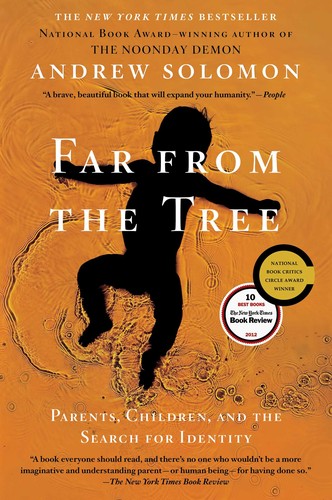
Far from the Tree: Parents, Children, and the Search for Identity by Andrew Solomon is a 2012 psychology book about identity, family, disability. Horizontal identity — identity shared with peers rather than inherited from family — creates a gap between parent and child that requires active work to bridge rather than natural inheritance to transmit.
Summary
Andrew Solomon's book is a ten-year investigation into families raising children who are profoundly different from their parents — deaf children of hearing parents, children with Down syndrome, autism, schizophrenia, severe physical disabilities, and other conditions that create what Solomon calls "horizontal identity": an identity shared with peers rather than inherited from family. The book also covers children who are prodigies, who were conceived in rape, and who become criminals. In each case Solomon asks the same question: how do parents and children find meaning in a profound mismatch of identity, and what does that process tell us about love?
Solomon distinguishes vertical identity, which is transmitted within a family — language, religion, ethnicity, values — from horizontal identity, which arrives in the child without parental precedent. Deaf parents of deaf children transmit an identity; hearing parents of deaf children must negotiate a gap that neither party chose. The book's central tension is between the medical model, which frames these conditions as deficits to be corrected, and the identity model, which sees them as valid ways of being human that deserve acknowledgment and accommodation. Solomon takes the identity model seriously without dismissing the medical one.
The chapters are long and deeply reported. Solomon interviewed more than three hundred families and synthesized their stories with neuroscience, disability studies, cultural history, and his own experience as a gay man whose identity was initially rejected by his family. The result is a book that functions simultaneously as journalism, scholarship, and memoir. The interviews are extraordinary — Solomon has a gift for drawing out the complexity of feelings that parents and children are often not given language to express. The grief, guilt, love, and unexpected meaning in each chapter are specific and earned.
The book's scope is also its challenge: at over nine hundred pages, it requires sustained commitment. Some chapters are more fully realized than others. But the core argument — that human difference is not a problem to be solved but a condition that calls for a particular kind of love and social accommodation — accumulates force with each case study. Far from the Tree is a book that makes it harder to see disability, difference, or difficult children as simple tragedies.
Talk to Far from the Tree: Parents, Children, and the Search for Identity like its author wrote you back.
Get the ideas that fit your life — not generic summaries.
- Chat with the book
- Audiobook-style main ideas
- Adapts to your life and goals
- Helps you take action
Key takeaways
- 1.
Horizontal identity — identity shared with peers rather than inherited from family — creates a gap between parent and child that requires active work to bridge rather than natural inheritance to transmit.
- 2.
The medical model and the identity model of disability reflect genuinely different values, not just different facts. Choosing between them involves moral judgment, not just clinical evidence.
- 3.
Parents of profoundly different children frequently report unexpected meaning and expansion of their own capacity for love, even as they acknowledge the weight of their situation honestly.
- 4.
Deaf culture's resistance to cochlear implants is a paradigm case of the identity model: the community argues that deafness is not a deficit but a different way of being in the world with its own language and culture.
- 5.
The experience of raising a very different child often forces parents to confront which of their values are genuinely held and which are reflections of social expectation.
- 6.
Solomon argues that the decision to have children with certain disabilities — Down syndrome, for instance — involves ethical complexity that neither pro-life nor pro-choice framings adequately address.
- 7.
Children who were conceived in rape present a case study in extreme mismatch between origin and identity: many such children grow up loved and loving, while their mothers' experience ranges across the full spectrum.
- 8.
What parents fear most about their child's difference often has more to do with social stigma and their own sense of identity than with the child's actual experience of their life.
Discussion questions
Use these on your own, with a book club, or as chat starters in Superbook. Book club version, ready to copy or print →
- 1.
Solomon distinguishes vertical from horizontal identity. Which aspects of your own identity were transmitted vertically from your family, and which did you have to find elsewhere?
- 2.
The deaf community's resistance to cochlear implants is presented seriously. Do you find the identity model of deafness persuasive, and what are the limits of applying it to children too young to consent?
- 3.
Solomon argues that the question 'what makes a life worth living?' is unavoidable for parents of severely disabled children. How would you answer it, and what assumptions does your answer rely on?
- 4.
The book reports that many parents of profoundly different children describe their lives as unexpectedly enriched. How do you evaluate that claim — is it credible, or a coping mechanism, or both?
- 5.
Which chapter or case in the book made you most uncomfortable, and what does that discomfort reveal about your assumptions?
- 6.
Solomon is gay and draws on his own experience of horizontal identity throughout the book. How does his personal stake in the subject strengthen or complicate the argument?
- 7.
The book covers both disability and criminality as forms of difference that create mismatch between parent and child. Is that comparison illuminating or does it risk conflating very different situations?
- 8.
What obligations do societies have toward children with severe differences that parents cannot fully meet? Where should the boundary between family and state responsibility lie?
- 9.
Solomon describes how some parents grieve the child they expected before coming to love the child they have. Is that grief legitimate, and how should it be held alongside love for the actual child?
- 10.
The book is nearly a thousand pages long. What does the length itself argue — is exhaustiveness part of the ethical stance, or is it excess?
- 11.
If you were a parent in one of the situations Solomon describes, which identity model — medical or social — do you think you would be drawn to, and why?
- 12.
Solomon ends with an argument for radical acceptance alongside genuine provision of care and treatment. Is that combination coherent, or does it require resolving a tension that can't be resolved?
Themes
Frequently asked questions
-
Is Far from the Tree worth reading at nearly 1000 pages?
Yes, if the subject genuinely interests you. The length is real but the chapters can be read semi-independently by topic. Most readers find themselves reading selectively rather than straight through. The depth of reporting and the quality of Solomon's thinking justify the commitment.
-
What is Far from the Tree actually about?
It is about the experience of parents raising children who are profoundly different from themselves — through disability, mental illness, criminality, prodigy, or other conditions. Solomon asks how families find love and meaning across that difference, and what it reveals about identity, acceptance, and what we owe each other.
-
Who should read this book?
Parents of children with disabilities or significant differences, clinicians who work with those families, disability scholars, and anyone who has thought seriously about identity, difference, and what it means to love someone you don't fully understand. It is not a self-help book but a deeply reported work of argument and journalism.
-
What is the central idea of the book?
That the gap between parents and profoundly different children is a site of extraordinary moral and emotional work. Solomon argues that accepting difference — not normalizing it or erasing it — is a form of love that requires society's support, not just individual heroism.
-
What is the book's most controversial section?
The chapter on children conceived in rape, which challenges readers to separate their feelings about how a child came into being from how that child's life unfolds. Solomon interviews both mothers and children with results that resist easy conclusions.
Similar books
Being Mortal: Medicine and What Matters in the End
Atul Gawande
Daring Greatly
Brené Brown
The Body Keeps the Score
Bessel van der Kolk
Grit: The Power of Passion and Perseverance
Angela Duckworth
