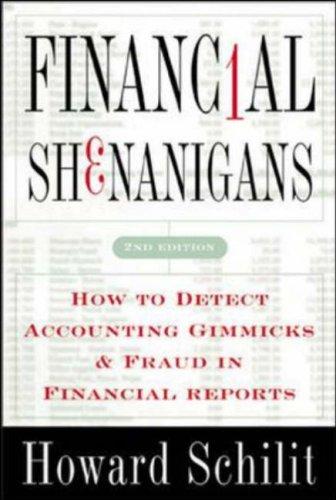
Talk to Financial Shenanigans like its author wrote you back.
Get the ideas that fit your life — not generic summaries.
- Chat with the book
- Audiobook-style main ideas
- Adapts to your life and goals
- Helps you take action
Financial Shenanigans, in detail
Financial Shenanigans is Howard Schilit's guide to the tricks companies use to make their financial results look better than they are — and how a careful reader of financial statements can spot them before they explode. Schilit, a former accounting professor who later founded a financial forensics firm that exposed dozens of corporate frauds, organized the original 1993 book around seven categories of accounting manipulation. Later editions expanded the taxonomy, but the core framework remains: companies deceive investors primarily by inflating reported revenues, understating expenses, or manipulating the balance sheet and cash flow statement.
The book is methodical and specific. Each category of shenanigan gets a chapter with real-world examples showing exactly which line items to examine, which ratios to calculate, and which warning signs — what Schilit calls "red flags" — indicate possible manipulation. Revenue recognition shenanigans include recording revenue before it's earned, using one-time gains to boost operating income, or using related-party transactions to manufacture sales. Expense manipulation includes capitalizing costs that should be expensed, releasing reserves to inflate earnings, or timing expense recognition to smooth reported results.
Beyond the individual techniques, the book makes a broader argument: reported earnings are a management-controlled number, and cash flow from operations is much harder to fake sustainably. A company that consistently reports growing profits while generating weak or declining operating cash flow deserves skepticism. The divergence between earnings and cash flow is Schilit's most powerful single diagnostic, and it has caught more frauds than any other single test.
Financial Shenanigans requires basic accounting literacy to get full value from it — readers unfamiliar with income statements, balance sheets, and cash flow statements will need to do some remedial work first. But for investors who want to go beyond surface-level financial analysis, it's one of the most practically useful books available. The fact that the frauds it describes include Sunbeam, Enron, WorldCom, and dozens of others that later became infamous gives the book an eerie credibility.
The big ideas
- 1.
Reported earnings are management-controlled; cash flow from operations is much harder to manipulate, making the divergence between the two the most important diagnostic signal.
- 2.
The seven shenanigan categories cover inflation of revenues, understatement of expenses, balance sheet manipulation, and cash flow deception — each with specific detection techniques.
- 3.
Aggressive revenue recognition — booking revenue before it's earned, using bill-and-hold transactions, or relying heavily on one-time items — is among the most common and detectable forms of manipulation.
