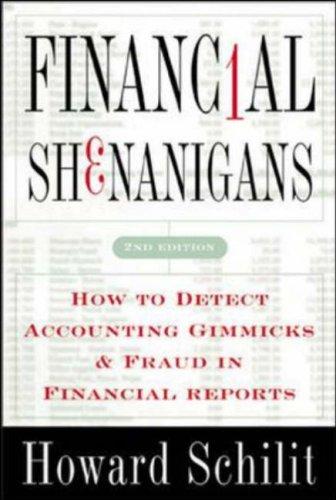
Financial Shenanigans by Howard M. Schilit is a 1993 business book about accounting fraud, financial analysis, earnings manipulation. Reported earnings are management-controlled; cash flow from operations is much harder to manipulate, making the divergence between the two the most important diagnostic signal.
Summary
Financial Shenanigans is Howard Schilit's guide to the tricks companies use to make their financial results look better than they are — and how a careful reader of financial statements can spot them before they explode. Schilit, a former accounting professor who later founded a financial forensics firm that exposed dozens of corporate frauds, organized the original 1993 book around seven categories of accounting manipulation. Later editions expanded the taxonomy, but the core framework remains: companies deceive investors primarily by inflating reported revenues, understating expenses, or manipulating the balance sheet and cash flow statement.
The book is methodical and specific. Each category of shenanigan gets a chapter with real-world examples showing exactly which line items to examine, which ratios to calculate, and which warning signs — what Schilit calls "red flags" — indicate possible manipulation. Revenue recognition shenanigans include recording revenue before it's earned, using one-time gains to boost operating income, or using related-party transactions to manufacture sales. Expense manipulation includes capitalizing costs that should be expensed, releasing reserves to inflate earnings, or timing expense recognition to smooth reported results.
Beyond the individual techniques, the book makes a broader argument: reported earnings are a management-controlled number, and cash flow from operations is much harder to fake sustainably. A company that consistently reports growing profits while generating weak or declining operating cash flow deserves skepticism. The divergence between earnings and cash flow is Schilit's most powerful single diagnostic, and it has caught more frauds than any other single test.
Financial Shenanigans requires basic accounting literacy to get full value from it — readers unfamiliar with income statements, balance sheets, and cash flow statements will need to do some remedial work first. But for investors who want to go beyond surface-level financial analysis, it's one of the most practically useful books available. The fact that the frauds it describes include Sunbeam, Enron, WorldCom, and dozens of others that later became infamous gives the book an eerie credibility.
Talk to Financial Shenanigans like its author wrote you back.
Get the ideas that fit your life — not generic summaries.
- Chat with the book
- Audiobook-style main ideas
- Adapts to your life and goals
- Helps you take action
Key takeaways
- 1.
Reported earnings are management-controlled; cash flow from operations is much harder to manipulate, making the divergence between the two the most important diagnostic signal.
- 2.
The seven shenanigan categories cover inflation of revenues, understatement of expenses, balance sheet manipulation, and cash flow deception — each with specific detection techniques.
- 3.
Aggressive revenue recognition — booking revenue before it's earned, using bill-and-hold transactions, or relying heavily on one-time items — is among the most common and detectable forms of manipulation.
- 4.
Capitalizing expenses rather than recognizing them on the income statement inflates current profits while hiding the true cost of running the business.
- 5.
Reserve manipulation — creating large reserves in good years and releasing them in bad years — is a classic earnings smoothing technique that obscures actual operating volatility.
- 6.
Acquisition accounting provides abundant opportunity for manipulation: classifying ongoing costs as one-time charges, inflating goodwill, or restating prior periods to make post-acquisition growth appear stronger.
- 7.
Related-party transactions — where a company does business with entities controlled by insiders — deserve heightened skepticism and careful examination.
- 8.
No single red flag proves fraud, but clustering of multiple warning signs across revenue, expense, and balance sheet items is a reliable signal to dig deeper or exit the position.
Discussion questions
Use these on your own, with a book club, or as chat starters in Superbook. Book club version, ready to copy or print →
- 1.
Schilit argues that cash flow from operations is harder to fake than earnings. Have you ever compared these two numbers for a company you own or are considering?
- 2.
Many of the frauds in the book were caught only after years of manipulation. What does that say about the reliability of auditing and analyst coverage for individual investors?
- 3.
Which shenanigan category surprised you most — and why might it be so common?
- 4.
The companies in the book often had enthusiastic analyst recommendations right before fraud became apparent. What does that suggest about how to use analyst ratings?
- 5.
How much accounting literacy do you think individual investors need to protect themselves? Is there a minimum below which they shouldn't be buying individual stocks?
- 6.
Schilit's work suggests that management integrity matters enormously. How do you currently evaluate management quality when considering an investment?
- 7.
The book covers cases where auditors missed or tolerated manipulation. Does knowing this change how much weight you give to clean audit opinions?
- 8.
What would need to be different about your investment process to actually implement the red flag checks Schilit describes?
- 9.
He shows that manipulation often starts small — a little reserve release here, a questionable capitalization there — before becoming systemic. What structural pressures drive that escalation?
- 10.
How do you think about the line between aggressive but legal accounting and fraud? Does the book change where you'd draw that line?
- 11.
If you manage any investments — retirement accounts, brokerage accounts — what changes would you make to your analysis process after reading this?
- 12.
Schilit's firm was paid to find accounting fraud. What incentives does that create, and do they affect how you weight his conclusions?
Themes
Frequently asked questions
-
Do I need an accounting background to read Financial Shenanigans?
Basic familiarity with income statements, balance sheets, and cash flow statements is helpful. Schilit explains the relevant accounting concepts as he goes, but readers with no background will find some chapters demanding. A brief review of financial statement basics before starting will make the book significantly more accessible.
-
Is the book still relevant given it uses older case studies?
The techniques it describes have been used in every major accounting scandal since publication. The mechanics of manipulation don't change much — only the specific instrument used to execute them. The principles and detection techniques transfer directly to any company's financial statements today.
-
What is the single most useful test from the book?
Comparing earnings growth to cash flow from operations growth. If earnings are rising while cash flow from operations is flat or declining, that divergence deserves serious investigation. It's not proof of fraud, but it's one of the most reliable early warning signs that reported profits may not reflect economic reality.
-
Who should read this book?
Individual investors who analyze company financial statements before buying stocks, portfolio managers, equity analysts, and anyone in a role that involves evaluating corporate financial reports. Also useful for journalists, short sellers, and auditors. Not particularly relevant for passive index investors.
-
Has the book been updated for more recent scandals?
Later editions added examples from Enron, WorldCom, and others from the early 2000s wave of fraud. The framework remains consistent across editions. The core seven shenanigan categories have proven durable enough that the updates are more illustrative than structural.
Similar books
The Intelligent Investor
Benjamin Graham
Common Stocks and Uncommon Profits
Philip A. Fisher
Thinking in Bets: Making Smarter Decisions When You Don't Have All the Facts
Annie Duke
A Random Walk Down Wall Street
Burton G. Malkiel
