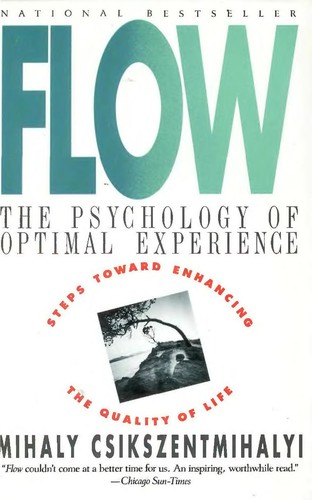
Talk to Flow: The Psychology of Optimal Experience like its author wrote you back.
Get the ideas that fit your life — not generic summaries.
- Chat with the book
- Audiobook-style main ideas
- Adapts to your life and goals
- Helps you take action
What it argues
Flow: The Psychology of Optimal Experience is Mihaly Csikszentmihalyi's account of his decades of research into the conditions under which people report feeling most alive, most engaged, and most fully themselves. He calls this state "flow" — the experience of complete absorption in a challenging activity, in which time seems to stop, self-consciousness disappears, and action and awareness merge. The book both describes how flow works and argues that organizing one's life around activities that produce it is the most reliable path to genuine happiness.
The research foundation is substantial. Csikszentmihalyi and his colleagues used the Experience Sampling Method — paging subjects at random intervals and asking what they were doing and how they felt — to gather data across tens of thousands of moments from people of different ages, occupations, and cultures. The consistent finding: people are happiest not during leisure or passive entertainment but when they are actively engaged in challenging tasks that match their skill level. Television makes people feel passive and slightly worse. Difficult work, at the edge of competence, makes them feel alive.
What it gets right
- 1.
Flow is the state of complete absorption in a challenging activity — a condition in which time seems to stop, self-consciousness disappears, and action and awareness merge.
- 2.
People are happiest not during passive leisure but during active, challenging engagement. Television tends to make people feel worse; difficult work that matches skill tends to make them feel better.
- 3.
The conditions for flow are specific: clear goals, immediate feedback, a challenge level that matches current skill, and a suspension of self-consciousness. These conditions can be created in almost any domain.
What it covers
Who wrote it
Mihaly Csikszentmihalyi (1934–2021) was a Hungarian-American psychologist and one of the founders of positive psychology. He spent most of his academic career at the University of Chicago and later at Claremont Graduate University. His concept of flow emerged from research he began in the 1960s on intrinsically rewarding activities. He developed the Experience Sampling Method, a technique for studying experience in real time rather than through retrospective report, which became a standard tool in psychological research. Flow, published in 1990, is his most widely read work, but his research appeared in dozens of papers and other books.
