Summary
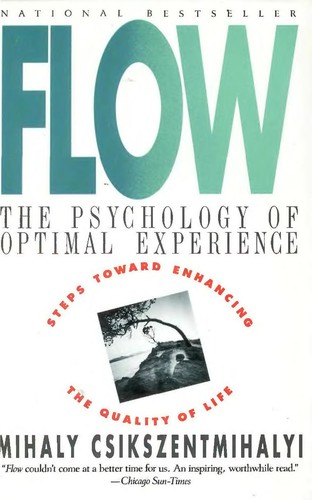
Flow: The Psychology of Optimal Experience is Mihaly Csikszentmihalyi's account of his decades of research into the conditions under which people report feeling most alive, most engaged, and most fully themselves. He calls this state "flow" — the experience of complete absorption in a challenging activity, in which time seems to stop, self-consciousness disappears, and action and awareness merge. The book both describes how flow works and argues that organizing one's life around activities that produce it is the most reliable path to genuine happiness.
The research foundation is substantial. Csikszentmihalyi and his colleagues used the Experience Sampling Method — paging subjects at random intervals and asking what they were doing and how they felt — to gather data across tens of thousands of moments from people of different ages, occupations, and cultures. The consistent finding: people are happiest not during leisure or passive entertainment but when they are actively engaged in challenging tasks that match their skill level. Television makes people feel passive and slightly worse. Difficult work, at the edge of competence, makes them feel alive.
The conditions for flow are specific: clear goals, immediate feedback on progress, a challenge level that matches the actor's current skill (neither too easy nor too overwhelming), and a suspension of self-consciousness. Csikszentmihalyi traces these conditions across activities as different as rock climbing, surgery, chess, and religious ritual. The form of the activity matters less than whether these structural conditions are met. This means, crucially, that flow can be found in almost any domain — including work, which most people mentally file under obligation rather than experience.
The book's scope expands in its final sections beyond individual psychology to ask what it would mean to design families, communities, and societies around the conditions for flow. These sections are less tightly argued than the psychological core, but the larger ambition is clear: Csikszentmihalyi is not writing a productivity manual. He is proposing a theory of the good life — one grounded in empirical research rather than philosophical abstraction — and the theory is that a life built around intrinsically rewarding, challenging engagement is both more meaningful and more reliably satisfying than one built around pleasure or comfort.
Talk to Flow: The Psychology of Optimal Experience like its author wrote you back.
Get the ideas that fit your life — not generic summaries.
- Chat with the book
- Audiobook-style main ideas
- Adapts to your life and goals
- Helps you take action
Key takeaways
- 1.
Flow is the state of complete absorption in a challenging activity — a condition in which time seems to stop, self-consciousness disappears, and action and awareness merge.
- 2.
People are happiest not during passive leisure but during active, challenging engagement. Television tends to make people feel worse; difficult work that matches skill tends to make them feel better.
- 3.
The conditions for flow are specific: clear goals, immediate feedback, a challenge level that matches current skill, and a suspension of self-consciousness. These conditions can be created in almost any domain.
- 4.
The optimal challenge-skill balance is the key structural element. Too easy produces boredom; too hard produces anxiety. Flow lives in the channel between them.
- 5.
Work can be a source of flow, but most people's mental model of work as obligation prevents them from approaching it in a way that would produce flow.
- 6.
Attention is the fundamental resource. How you deploy your attention across a life largely determines what kind of life you have. Flow is a particularly high-quality use of attention.
- 7.
Autotelic activities — those done for their own sake rather than for external rewards — are the primary sources of flow. Finding autotelic qualities in obligatory activities transforms the experience of work.
- 8.
A unified, coherent self — one whose goals and activities align — is both a prerequisite for and a product of flow. Complexity of the self grows through the repeated experience of optimal engagement.
Discussion questions
Use these on your own, with a book club, or as chat starters in Superbook.
- 1.
Think of the last time you were in flow — completely absorbed, self-forgetful, fully engaged. What were you doing, and what conditions made it possible?
- 2.
Csikszentmihalyi finds that people are happier during challenging work than during leisure, yet consistently prefer the idea of leisure. How do you experience this paradox in your own life?
- 3.
What activities in your life reliably produce flow? Are you deliberately organizing your time to spend more of it on them?
- 4.
Where is your current work most consistently in the flow channel — challenging enough to engage you but not so overwhelming as to produce anxiety? Where is it outside that channel?
- 5.
Csikszentmihalyi argues that passive consumption — television, scrolling — consistently produces lower quality experience than active engagement. Does that finding match your own felt experience?
- 6.
The autotelic self transforms external constraints into intrinsically rewarding engagement. Is there an area of obligatory work where you could apply that shift? What would it require?
- 7.
Flow requires clear goals and immediate feedback. Which of your important activities currently lack those elements? What would it take to add them?
- 8.
Csikszentmihalyi says the quality of a life is determined largely by how one deploys attention. Looking at the last week, what did you give your best attention to? Was it the right thing?
- 9.
The book was first published in 1990 and the research behind it largely predates smartphones and social media. How does the attention economy of 2026 change the difficulty of achieving flow?
- 10.
Csikszentmihalyi extends his argument to family life and communities. What would a family culture optimized for flow actually look like, and how far is yours from that?
- 11.
Flow experiences often involve pushing against one's current skill ceiling. Where in your life are you systematically avoiding challenges at that level, and what does that avoidance cost you?
- 12.
The book ends with the question of what a meaningful life looks like. Does Csikszentmihalyi's answer — a life organized around intrinsically rewarding, challenging engagement — satisfy you as a complete account of the good life?
Themes
Frequently asked questions
-
What is flow, according to Csikszentmihalyi?
Flow is the state of complete absorption in a challenging activity. During flow, time seems to stop, self-consciousness disappears, and action and awareness merge. It requires clear goals, immediate feedback, and a challenge level that matches your current skill — neither too easy nor too hard.
-
Is Flow worth reading?
Yes. The psychological research is solid and the central insight — that people are most alive during challenging, intrinsically rewarding engagement, not during passive leisure — is both counterintuitive and well-supported. The later chapters on society and the good life are less tightly argued, but the core is genuinely useful.
-
How long does it take to read Flow?
About five to six hours at average reading pace. The book is around 300 pages in most editions. It is more academic in tone than popular psychology books published since, and rewards patient reading.
-
What is the most actionable idea in Flow?
The challenge-skill balance. Identify any activity where you are bored because it is too easy, and deliberately increase the difficulty. Identify any activity where you are anxious because it is too hard, and build the skills to close the gap. This simple adjustment can transform the quality of experience across a wide range of activities.
-
How does Flow relate to Deep Work by Cal Newport?
The books address overlapping territory. Newport focuses specifically on knowledge work and argues for protecting time for undistracted concentration. Csikszentmihalyi's framework is broader and more psychological, but both agree that sustained challenging engagement produces better experience and better output than fragmented, shallow activity.
-
Who should read Flow?
Anyone who feels that their life contains less engagement and aliveness than they want — whether in work, relationships, or leisure. It is especially useful for people who are productive on the outside but feel vaguely unsatisfied, and for those designing work or learning environments for others.