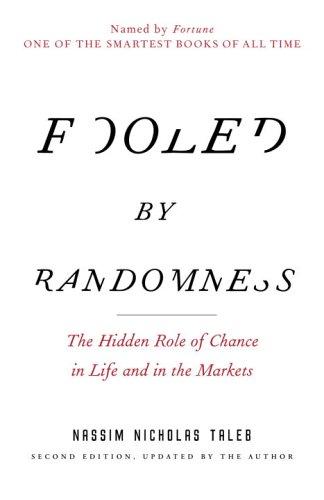
Talk to Fooled by Randomness like its author wrote you back.
Get the ideas that fit your life — not generic summaries.
- Chat with the book
- Audiobook-style main ideas
- Adapts to your life and goals
- Helps you take action
What it argues
Fooled by Randomness is Nassim Nicholas Taleb's argument that humans are wired to misread luck as skill, noise as signal, and random outcomes as the product of ability or effort. Writing from his background as a derivatives trader, Taleb makes the case that we systematically underestimate how much randomness shapes the events we observe — in markets, in careers, and in daily life — and that this blind spot has real consequences for how we make decisions.
The core problem Taleb identifies is survivorship bias. We see the winners of any competitive process and build theories about what made them successful, while the losers — who may have behaved identically — disappear from view. The successful trader looks like a genius; the hundreds who blew up running the same strategy are invisible. This skews our perception of what works, and it leads us to attribute outcomes to narratives when the honest explanation is chance. Taleb is particularly unsparing about financial professionals, whose track records he argues are largely indistinguishable from what you would expect from random coin-flipping.
What it gets right
- 1.
Survivorship bias makes winners look skilled and losers disappear. We build theories of success from a sample that excludes everyone who failed doing the same thing.
- 2.
A string of successful outcomes tells you very little about whether a strategy works. A dentist who made money in markets last year may have simply gotten lucky, and last year's returns don't update the odds.
- 3.
We are wired to construct causal narratives. When a sequence of events occurs, the brain assigns meaning to it even when the honest explanation is random variation.
What it covers
Who wrote it
Nassim Nicholas Taleb is a Lebanese-American essayist, statistician, and former derivatives trader. He is the author of the Incerto series, which includes The Black Swan, Antifragile, The Bed of Procrustes, and Skin in the Game — a multi-volume exploration of uncertainty, probability, and decision-making under conditions of incomplete knowledge. Fooled by Randomness, first published in 2001, was the book that introduced his ideas to a wide audience. Taleb has held academic positions at New York University and the University of Massachusetts Amherst and continues to write and consult on risk and probability.
