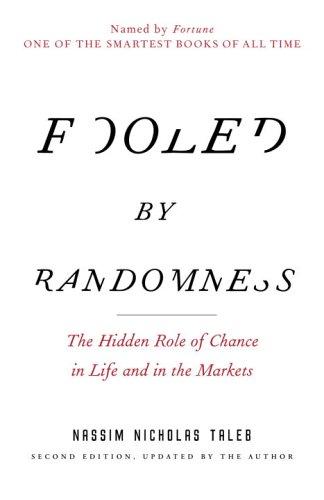
Fooled by Randomness by Nassim Nicholas Taleb is a 2001 psychology book about randomness, probability, cognitive bias. Survivorship bias makes winners look skilled and losers disappear. We build theories of success from a sample that excludes everyone who failed doing the same thing.
Summary
Fooled by Randomness is Nassim Nicholas Taleb's argument that humans are wired to misread luck as skill, noise as signal, and random outcomes as the product of ability or effort. Writing from his background as a derivatives trader, Taleb makes the case that we systematically underestimate how much randomness shapes the events we observe — in markets, in careers, and in daily life — and that this blind spot has real consequences for how we make decisions.
The core problem Taleb identifies is survivorship bias. We see the winners of any competitive process and build theories about what made them successful, while the losers — who may have behaved identically — disappear from view. The successful trader looks like a genius; the hundreds who blew up running the same strategy are invisible. This skews our perception of what works, and it leads us to attribute outcomes to narratives when the honest explanation is chance. Taleb is particularly unsparing about financial professionals, whose track records he argues are largely indistinguishable from what you would expect from random coin-flipping.
Beyond survivorship bias, Taleb surveys the cognitive errors that compound the problem: the tendency to mistake emotional comfort for epistemic validity, to treat hindsight as foresight, to build elaborate causal stories around events that had many possible outcomes. He draws on Kahneman and Tversky's research on heuristics and biases, on Popper's ideas about falsifiability, and on Montaigne's skepticism toward authority. The book ranges widely — from ancient Stoic philosophy to modern probability theory — and Taleb's voice is deliberately opinionated and sometimes combative.
What separates Fooled by Randomness from a statistics textbook is the emotional honesty about how difficult it is to actually internalize these lessons. Taleb admits he still flinches at market losses he intellectually knows are noise. The book is not a manual for eliminating cognitive bias; it is more of a sustained reminder that you are probably fooled right now, and that intellectual humility about luck is harder to maintain than it sounds. It rewards readers willing to sit with uncertainty rather than those looking for a neat framework to apply.
Talk to Fooled by Randomness like its author wrote you back.
Get the ideas that fit your life — not generic summaries.
- Chat with the book
- Audiobook-style main ideas
- Adapts to your life and goals
- Helps you take action
Key takeaways
- 1.
Survivorship bias makes winners look skilled and losers disappear. We build theories of success from a sample that excludes everyone who failed doing the same thing.
- 2.
A string of successful outcomes tells you very little about whether a strategy works. A dentist who made money in markets last year may have simply gotten lucky, and last year's returns don't update the odds.
- 3.
We are wired to construct causal narratives. When a sequence of events occurs, the brain assigns meaning to it even when the honest explanation is random variation.
- 4.
Hindsight feels like foresight. After an event happens, it seems inevitable in retrospect, which creates a false sense that it was predictable — and that next time will be too.
- 5.
Rare, high-impact events (Taleb calls them black swans in his later work) are systematically underweighted because they haven't happened recently, not because they're genuinely unlikely.
- 6.
Emotion and intelligence operate on different timescales. Taleb knows intellectually that a market dip is noise but still feels the pain — proof that rationality doesn't immunize you against bias.
- 7.
Ergodicity matters: an outcome that looks good on average across many people can still ruin any single individual if the distribution includes catastrophic tail losses.
- 8.
The best response to randomness is often structural rather than cognitive: limit downside exposure so that a bad random outcome can't be fatal, regardless of how confident you feel about a forecast.
Discussion questions
Use these on your own, with a book club, or as chat starters in Superbook. Book club version, ready to copy or print →
- 1.
Taleb argues that in many competitive fields, the visible winners are largely indistinguishable from lucky survivors. Which field in your own experience fits that description most closely?
- 2.
Think of a personal or professional success you're proud of. How much of it, honestly, was luck — being in the right place, knowing the right person, or avoiding a bad outcome that could easily have gone the other way?
- 3.
Survivorship bias shapes what we read, who we admire, and which strategies we copy. Where do you most often encounter it, and how has it influenced decisions you've made?
- 4.
Taleb is harsh about financial journalists and market commentators who construct narratives after the fact. What other domains generate confident post-hoc explanations that probably don't hold up?
- 5.
He describes the emotional difficulty of watching his portfolio drop even when he intellectually knows the drop is noise. Have you experienced a similar gap between what you know and what you feel in a high-stakes situation?
- 6.
The book argues that a long track record in a random environment is weak evidence of skill. How would you change the way you evaluate expertise in a domain you rely on — a doctor, a financial advisor, a manager?
- 7.
Taleb draws on Stoic philosophy as a way of coping with uncertainty without being paralyzed by it. Is that approach useful to you, or does it feel like resignation rather than strategy?
- 8.
What's the most important decision you've made in the last five years where randomness played a larger role than you initially admitted to yourself?
- 9.
He argues we should structure our lives to limit the impact of catastrophic random events rather than trying to predict them. What would that look like concretely in your financial, professional, or health decisions?
- 10.
Taleb's tone is deliberately contrarian and sometimes dismissive of people he considers naive about probability. Does that voice make the argument more or less persuasive to you personally?
- 11.
He distinguishes between noise (short-term random fluctuation) and signal (meaningful information). In your own work or life, which of the things you pay close attention to is probably just noise?
- 12.
The book was written in 2001, before the 2008 financial crisis that made Taleb famous. Does knowing what happened afterward change how you read his earlier arguments about fat tails and hidden risk?
Themes
Frequently asked questions
-
What is Fooled by Randomness about?
It is Nassim Taleb's argument that humans systematically mistake luck for skill and random outcomes for the result of talent or effort. Using examples from financial markets, history, and everyday life, Taleb shows how survivorship bias, hindsight, and emotional reasoning lead us to build false narratives around events that were largely shaped by chance.
-
Is Fooled by Randomness worth reading?
Yes, especially if you work in any field where outcomes are hard to measure or where a few visible winners attract disproportionate attention. The ideas around survivorship bias and narrative fallacy are genuinely corrective. Taleb's combative tone puts some readers off, but the core argument is both rigorous and uncomfortable in the right way.
-
How long does it take to read Fooled by Randomness?
Around four to five hours at average reading pace. The chapters are loosely structured and essayistic rather than linear, which makes it easy to read in sections but occasionally hard to follow the throughline in a single sitting.
-
How does Fooled by Randomness relate to The Black Swan?
Fooled by Randomness came first and covers the general problem of randomness and cognitive bias. The Black Swan focuses specifically on rare, high-impact events that fall outside normal probability distributions. Reading Fooled by Randomness first provides useful grounding for the later book.
-
Who should read Fooled by Randomness?
Investors, managers, and anyone who evaluates performance for a living will find the survivorship-bias argument especially pointed. It is also useful for readers interested in probability and cognitive science who want a more opinionated and personal treatment than a standard textbook.
-
What is the main practical takeaway from Fooled by Randomness?
Structure decisions to limit catastrophic downside rather than trying to predict the future more accurately. Since you cannot reliably distinguish noise from signal in real time, the more durable strategy is ensuring that bad random outcomes don't ruin you — rather than betting that your forecast is correct.
Similar books
Thinking, Fast and Slow
Daniel Kahneman
The Black Swan: The Impact of the Highly Improbable
Nassim Nicholas Taleb
Antifragile: Things That Gain from Disorder
Nassim Nicholas Taleb
Predictably Irrational
Dan Ariely
