Talk to Founders at Work: Stories of Startups' Early Days like its author wrote you back.
Get the ideas that fit your life — not generic summaries.
- Chat with the book
- Audiobook-style main ideas
- Adapts to your life and goals
- Helps you take action
Founders at Work: Stories of Startups' Early Days, in detail
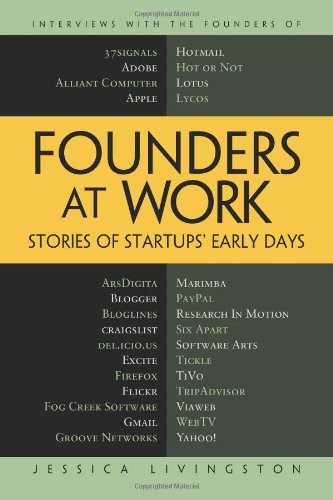
Founders at Work is Jessica Livingston's collection of interviews with the founders of some of the most influential technology companies of the late twentieth and early twenty-first centuries. Livingston, who co-founded Y Combinator with Paul Graham, conducted the interviews herself. The book covers Apple, Hotmail, PayPal, Flickr, TiVo, Gmail, del.icio.us, and about twenty-five other companies, interviewing the people who were actually in the room — Steve Wozniak, Caterina Fake, Max Levchin, Joel Spolsky, and others — and asking them primarily about what it was like in the earliest days.
The book's method is simple and its value comes from that simplicity. Livingston asks every founder roughly the same questions: what were the early days like, what was hardest, what mistakes did they make, how did they find their first users, and what did they know at the time that seemed obvious to them but turned out to be unusual? The consistency of the questions makes the book feel like a primary source rather than a curated narrative. You're reading founders talk about their own experience without significant editorial shaping.
Several themes recur throughout the interviews. Nearly every founder describes a period of extreme scrappiness — building in cramped apartments, delaying salaries, doing customer support personally while also writing code. Nearly every founder describes underestimating how long the company would take to find its footing. And nearly every founder describes a key moment of clarity — sometimes a single conversation, sometimes a feature decision — that retroactively looks like the pivot that mattered.
As a historical document of a specific moment in technology history, Founders at Work is invaluable. The companies described are mostly from the 1980s through the early 2000s, which means the environment (pre-iPhone, pre-social media, before cloud infrastructure) is dated in some respects. But the human experience of starting a company — the uncertainty, the dependence on early believers, the tension between the original vision and what users actually want — has not changed, and Livingston's interviews capture it with unusual fidelity.
The big ideas
- 1.
The scrappiness of early days is not a phase to get through — it's often the period when the most important decisions are made, when the company's character is formed, and when founders are closest to the actual work.
- 2.
Nearly every founder describes underestimating how long it would take to find product-market fit. The assumption that early traction would compound quickly was almost universally wrong.
- 3.
First users matter more than most founders give them credit for. The founders in this book who paid close attention to what their first hundred users did — not said — made better product decisions than those who extrapolated from what users said they wanted.
