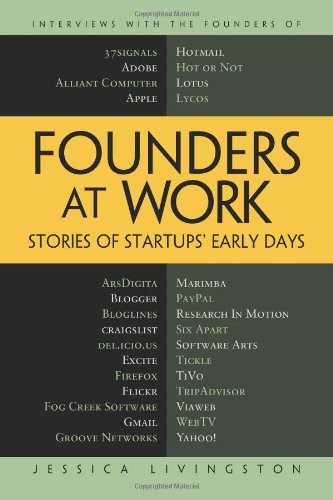
Founders at Work: Stories of Startups' Early Days by Jessica Livingston is a 2007 business book about entrepreneurship, founder stories, startups. The scrappiness of early days is not a phase to get through — it's often the period when the most important decisions are made, when the company's character is formed, and when founders are closest to the actual work.
Summary
Founders at Work is Jessica Livingston's collection of interviews with the founders of some of the most influential technology companies of the late twentieth and early twenty-first centuries. Livingston, who co-founded Y Combinator with Paul Graham, conducted the interviews herself. The book covers Apple, Hotmail, PayPal, Flickr, TiVo, Gmail, del.icio.us, and about twenty-five other companies, interviewing the people who were actually in the room — Steve Wozniak, Caterina Fake, Max Levchin, Joel Spolsky, and others — and asking them primarily about what it was like in the earliest days.
The book's method is simple and its value comes from that simplicity. Livingston asks every founder roughly the same questions: what were the early days like, what was hardest, what mistakes did they make, how did they find their first users, and what did they know at the time that seemed obvious to them but turned out to be unusual? The consistency of the questions makes the book feel like a primary source rather than a curated narrative. You're reading founders talk about their own experience without significant editorial shaping.
Several themes recur throughout the interviews. Nearly every founder describes a period of extreme scrappiness — building in cramped apartments, delaying salaries, doing customer support personally while also writing code. Nearly every founder describes underestimating how long the company would take to find its footing. And nearly every founder describes a key moment of clarity — sometimes a single conversation, sometimes a feature decision — that retroactively looks like the pivot that mattered.
As a historical document of a specific moment in technology history, Founders at Work is invaluable. The companies described are mostly from the 1980s through the early 2000s, which means the environment (pre-iPhone, pre-social media, before cloud infrastructure) is dated in some respects. But the human experience of starting a company — the uncertainty, the dependence on early believers, the tension between the original vision and what users actually want — has not changed, and Livingston's interviews capture it with unusual fidelity.
Talk to Founders at Work: Stories of Startups' Early Days like its author wrote you back.
Get the ideas that fit your life — not generic summaries.
- Chat with the book
- Audiobook-style main ideas
- Adapts to your life and goals
- Helps you take action
Key takeaways
- 1.
The scrappiness of early days is not a phase to get through — it's often the period when the most important decisions are made, when the company's character is formed, and when founders are closest to the actual work.
- 2.
Nearly every founder describes underestimating how long it would take to find product-market fit. The assumption that early traction would compound quickly was almost universally wrong.
- 3.
First users matter more than most founders give them credit for. The founders in this book who paid close attention to what their first hundred users did — not said — made better product decisions than those who extrapolated from what users said they wanted.
- 4.
Many of the companies in the book succeeded because of a timing advantage the founders didn't fully recognize at the time. Being early to a platform shift or distribution channel matters more than most strategic planning accounts for.
- 5.
Technical co-founders with complementary skills (builder and seller, or two builders with different domain expertise) appear more often in successful outcomes than solo founders across the sample.
- 6.
Persistence through the 'trough of disillusionment' is nearly universal. Almost every founder describes a period when the obvious play was to quit, and they didn't.
- 7.
Investors who provided useful introductions or insight mattered; investors who just provided capital mattered much less than founders expected before they took the money.
- 8.
The original idea rarely survived intact. The companies that succeeded had founders willing to change almost everything except the core conviction about what problem they were solving.
Discussion questions
Use these on your own, with a book club, or as chat starters in Superbook. Book club version, ready to copy or print →
- 1.
Livingston conducts all the interviews herself with consistent questions. What do you think that consistency surfaces that a more edited oral history would miss?
- 2.
Which founder's story in the book surprised you most, and why?
- 3.
The companies described are mostly from the 1980s to early 2000s. How different do you think the early days of those companies would look if they were founded today?
- 4.
Nearly every founder describes a period when they could have quit and it would have seemed reasonable. What seems to separate founders who persist from those who stop?
- 5.
Several founders describe not realizing they were doing something historically significant until much later. What does that suggest about how you know when what you're building matters?
- 6.
The book covers technical founders almost exclusively. What experiences from early days do you think founders without technical backgrounds might describe differently?
- 7.
The founding team dynamic — co-founders, early employees, first investors — comes up repeatedly. What does the book suggest about who you want around you in the earliest days?
- 8.
Many founders describe luck as a factor: being early to a platform, meeting the right investor at the right time. How much of what these founders accomplished was skill versus luck versus timing?
- 9.
The founders are almost uniformly self-critical about mistakes in retrospect. Which mistake type — product, team, strategy, fundraising — appears most often as the thing they'd change?
- 10.
Livingston co-founded Y Combinator. Do you think that background shapes which founders she chose to interview or how she conducted the conversations?
- 11.
The book ends with early 2000s companies. Which companies founded since then would you most want to see interviewed in the same format?
- 12.
If you read this book as someone who has never started a company, what does it tell you about what you're probably underestimating?
Themes
Frequently asked questions
-
Is Founders at Work worth reading?
Yes, particularly if you want primary-source accounts of what building a company actually felt like in the early days of the internet era. It's a long book and not every interview is equally compelling, but the best ones — Wozniak, Levchin, Fake — are exceptional. The book reads more like oral history than business advice.
-
How long does it take to read Founders at Work?
Around eight to nine hours for the full book. The interview format means you can read individual chapters independently, which makes it practical to pick up and put down. Most readers read it nonlinearly, starting with the companies they know best.
-
Which interview in Founders at Work is most worth reading?
Steve Wozniak's account of the early Apple days is one of the most vivid. Max Levchin on PayPal and Caterina Fake on Flickr are also consistently cited as highlights. The depth varies, but Livingston's consistent questions mean even the shorter interviews reveal something.
-
Who should read Founders at Work?
Anyone considering starting a company, interested in technology history, or curious about what the early days of iconic companies actually looked like. The book is a better preparation for entrepreneurship than most frameworks because it conveys the texture of the experience rather than advice about what to do.
-
What's the most surprising thing in Founders at Work?
How uniformly modest and uncertain the founders were during the period they're describing — not about their technical ability, but about whether the company would work. Almost none of them describe feeling confident that they were building something important while they were doing it.
Similar books
The Startup Playbook
David S. Kidder
Shoe Dog: A Memoir by the Creator of Nike
Phil Knight
The Hard Thing About Hard Things
Ben Horowitz
Zero to One: Notes on Startups, or How to Build the Future
Peter Thiel
