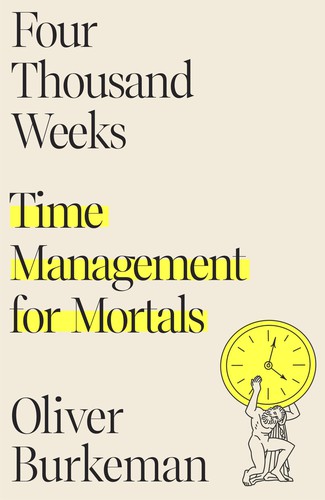
Talk to Four Thousand Weeks: Time Management for Mortals like its author wrote you back.
Get the ideas that fit your life — not generic summaries.
- Chat with the book
- Audiobook-style main ideas
- Adapts to your life and goals
- Helps you take action
Four Thousand Weeks: Time Management for Mortals, in detail
Four Thousand Weeks is Oliver Burkeman's philosophical attack on the entire project of time management as it is usually practiced. The title comes from the rough number of weeks in an eighty-year human life. Burkeman's argument is that most productivity advice is animated by an implicit fantasy: that if you just get efficient enough, inbox-zero enough, system-organized enough, you will eventually reach a state where you have done everything and can rest. This fantasy is a lie. You will never finish. The tasks expand to fill the time. The real question is not how to do everything but how to choose what to do when you can't do everything.
Burkeman traces much of modern anxiety about time to what he calls the "efficiency trap": the observation that becoming more productive typically generates more demands, so that faster processing leads to more, not less, overwhelm. He draws on Heidegger's concept of thrownness — the fact that we find ourselves alive without having chosen to be, with a finite span we cannot extend, and an obligation to decide how to use it — to argue that the real challenge of time management is an existential one, not a logistical one.
The book is deliberately anti-self-help in its prescriptions: instead of giving systems for doing more, it argues for doing less, choosing consciously, tolerating the anxiety of closed doors, and coming to terms with the fact that most of what you want to do will remain undone. Burkeman covers digital distraction, the psychology of procrastination, and the politics of busyness, but always in service of the larger point about finitude.
The final section offers what Burkeman calls "ten tools for embracing your finitude" — not techniques for optimization but orientations for a more honest relationship with limited time. Four Thousand Weeks is the most intellectually serious book about time to appear in years.
The big ideas
- 1.
You have roughly four thousand weeks. The question is not how to do everything but how to choose well among the infinite things you could do and cannot.
- 2.
The efficiency trap: becoming more productive typically generates more demand, not more freedom. Clearing your inbox faster teaches people to send you more email.
- 3.
Finitude is the defining condition of human experience, not a problem to be solved. Most productivity advice tries to escape it; the real task is to accept it and decide accordingly.
