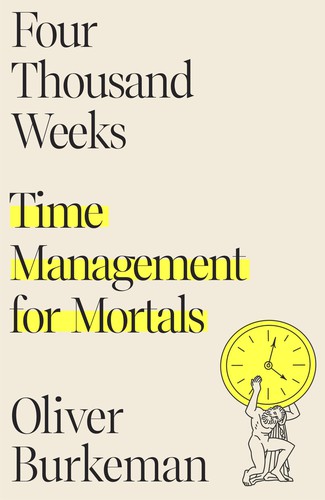
Four Thousand Weeks: Time Management for Mortals by Oliver Burkeman is a 2021 self-help book about time management, mortality, productivity. You have roughly four thousand weeks. The question is not how to do everything but how to choose well among the infinite things you could do and cannot.
Summary
Four Thousand Weeks is Oliver Burkeman's philosophical attack on the entire project of time management as it is usually practiced. The title comes from the rough number of weeks in an eighty-year human life. Burkeman's argument is that most productivity advice is animated by an implicit fantasy: that if you just get efficient enough, inbox-zero enough, system-organized enough, you will eventually reach a state where you have done everything and can rest. This fantasy is a lie. You will never finish. The tasks expand to fill the time. The real question is not how to do everything but how to choose what to do when you can't do everything.
Burkeman traces much of modern anxiety about time to what he calls the "efficiency trap": the observation that becoming more productive typically generates more demands, so that faster processing leads to more, not less, overwhelm. He draws on Heidegger's concept of thrownness — the fact that we find ourselves alive without having chosen to be, with a finite span we cannot extend, and an obligation to decide how to use it — to argue that the real challenge of time management is an existential one, not a logistical one.
The book is deliberately anti-self-help in its prescriptions: instead of giving systems for doing more, it argues for doing less, choosing consciously, tolerating the anxiety of closed doors, and coming to terms with the fact that most of what you want to do will remain undone. Burkeman covers digital distraction, the psychology of procrastination, and the politics of busyness, but always in service of the larger point about finitude.
The final section offers what Burkeman calls "ten tools for embracing your finitude" — not techniques for optimization but orientations for a more honest relationship with limited time. Four Thousand Weeks is the most intellectually serious book about time to appear in years.
Talk to Four Thousand Weeks: Time Management for Mortals like its author wrote you back.
Get the ideas that fit your life — not generic summaries.
- Chat with the book
- Audiobook-style main ideas
- Adapts to your life and goals
- Helps you take action
Key takeaways
- 1.
You have roughly four thousand weeks. The question is not how to do everything but how to choose well among the infinite things you could do and cannot.
- 2.
The efficiency trap: becoming more productive typically generates more demand, not more freedom. Clearing your inbox faster teaches people to send you more email.
- 3.
Finitude is the defining condition of human experience, not a problem to be solved. Most productivity advice tries to escape it; the real task is to accept it and decide accordingly.
- 4.
Convenience culture has eliminated friction from daily life, but friction is often where meaning lives. Choosing the harder, slower, more committed path is frequently the more satisfying one.
- 5.
Pay yourself first with attention: invest your best hours in what matters most before doing what is easy or urgent. This principle from financial planning applies even more powerfully to time.
- 6.
The real procrastination problem is not laziness but the anxiety of beginning work that will be inevitably imperfect. Resistance to starting is resistance to confronting the gap between your aspirations and your ability.
- 7.
Serialization — giving one project your full attention before starting the next — produces more and better output than spreading attention across multiple projects simultaneously.
- 8.
The 'when I finally' fantasy — when I finally have enough time, space, money, clarity — is a mechanism for avoiding the present decision. The conditions will never be perfect.
Discussion questions
Use these on your own, with a book club, or as chat starters in Superbook. Book club version, ready to copy or print →
- 1.
Burkeman argues that the fantasy of 'getting on top of everything' is structurally impossible. Does accepting that change how you feel about your current task list?
- 2.
What does the efficiency trap look like in your own life? Where has becoming faster or more organized generated more demand rather than more freedom?
- 3.
If you had only four thousand weeks from birth, and you've already spent some of them — how many remain? What does that number feel like?
- 4.
Burkeman makes a case for doing less and choosing more consciously. What would you give up, right now, if you took that seriously?
- 5.
He describes the 'when I finally' fantasy as a way of avoiding present decisions. Where in your own life are you waiting for conditions that will never arrive?
- 6.
Convenience culture has reduced friction in daily life. Where in your experience does friction — difficulty, effort, commitment — actually produce more satisfaction than convenience?
- 7.
Burkeman draws on Heidegger's concept of thrownness — finding yourself alive without choosing it. How does thinking of your life as thrown, rather than constructed, change what feels important?
- 8.
He argues that serialization produces better outcomes than parallel pursuit of multiple projects. What are you currently running in parallel that would benefit from finishing one before starting the next?
- 9.
What is the project or commitment you're most avoiding starting because the inevitable imperfection of beginning is uncomfortable?
- 10.
The book suggests that much of digital distraction is actually distraction from the anxiety of finitude — the fear of choosing poorly. Does that ring true for how you use your phone?
- 11.
Burkeman's prescriptions are anti-optimization: tolerate the anxiety, choose consciously, accept undone-ness. Is that genuinely satisfying advice, or does it feel like giving up?
- 12.
What would change about your daily schedule if you stopped pretending that you might eventually catch up and instead designed each day around what actually deserves your four thousand weeks?
Themes
Frequently asked questions
-
Is Four Thousand Weeks worth reading?
Yes, especially if you've read a lot of productivity books and found them unsatisfying despite implementing their advice. Burkeman offers a genuinely different lens — more philosophical, more honest about what time management can and cannot do. It is the best book about time that is not really about time management.
-
How long does it take to read Four Thousand Weeks?
About five hours at average pace. The writing is dense with ideas but not padded with case studies. Each chapter advances the argument rather than illustrating it with variations on the same example.
-
Is Four Thousand Weeks pessimistic?
Burkeman calls it 'tragic optimism' — accepting the constraints of human finitude while finding that acceptance more liberating than the impossible fantasy of doing everything. Readers who find it pessimistic are usually resisting the core premise.
-
What is the main practical advice in Four Thousand Weeks?
Invest your best attention in your most important commitments before the urgent crowds them out. Serialize your major projects rather than diluting attention across many. Accept that most things will remain undone, and choose which things rather than pretending you can do all of them.
-
Who should read Four Thousand Weeks?
People who have read a lot of productivity books and still feel overwhelmed, dissatisfied, or vaguely fraudulent about how they spend their time. Also useful for anyone going through a life transition who wants a serious framework for thinking about what to prioritize.