Talk to Freakonomics like its author wrote you back.
Get the ideas that fit your life — not generic summaries.
- Chat with the book
- Audiobook-style main ideas
- Adapts to your life and goals
- Helps you take action
Freakonomics, in detail
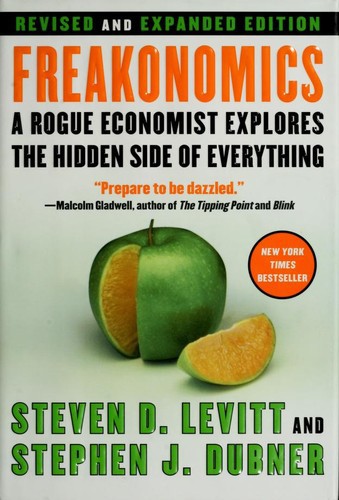
Freakonomics is economist Steven Levitt and journalist Stephen Dubner's argument that economics — properly understood as the study of incentives — can explain things that look, on the surface, like they have nothing to do with money. The book doesn't have a single thesis. Its organizing principle is a method: find good data, ask a question nobody thought to ask, and follow the numbers wherever they go, even if the answer is uncomfortable.
The most famous case is the argument that the legalization of abortion in the early 1970s, not policing tactics or economic growth, was the primary driver of the dramatic drop in crime rates in the 1990s. Levitt and Dubner trace the logic carefully: children born into circumstances where they are unwanted are statistically more likely to commit crimes, and when Roe v. Wade reduced those births, the effect showed up in crime data roughly eighteen years later. The chapter generated enormous controversy, and the authors engage it directly rather than hedge.
Other investigations are less incendiary but equally counterintuitive. Real estate agents, it turns out, have incentives to sell your house fast rather than get you the best price — their commission on an extra ten thousand dollars is smaller than the cost of waiting. Sumo wrestlers at the margin of promotion appear to throw matches. Drug dealers in Chicago, despite their apparent power, earn roughly minimum wage and live with their mothers because the economic structure of a gang resembles a franchise with very few spots at the top. Names given to children correlate with socioeconomic outcomes in ways that are mostly driven by class, not causation — the name itself doesn't determine the life.
The book's real contribution is not its conclusions, which are debatable and in some cases have been challenged on methodological grounds since publication. It's the habit of mind: distrust conventional wisdom, look for the hidden actor who benefits from a belief being held, check whether the data actually support the story you've been told. Levitt is a genuinely unusual empirical economist, and Dubner makes the research accessible without softening it. Not every chapter lands equally, and readers hoping for a unified theory of society will be disappointed. What they get instead is a collection of well-chosen provocations.
The big ideas
- 1.
Incentives are the central mechanism of human behavior. Understanding who benefits from a situation — financially, socially, or morally — often explains behavior that seems irrational on the surface.
- 2.
Conventional wisdom is frequently wrong, especially when it's propagated by people with an interest in maintaining it. The real estate industry, parenting experts, and crime analysts all get chapters making this point.
- 3.
The link between Roe v. Wade and the 1990s crime drop is Levitt's most controversial claim: reduced births into high-risk circumstances, not policing or the economy, best explains the timing and geography of the decline.
