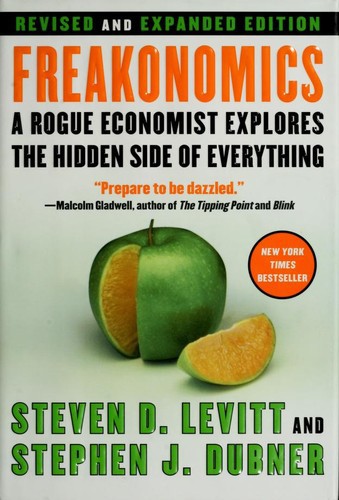
Freakonomics by Steven D. Levitt and Stephen J. Dubner is a 2005 economics book about incentives, hidden information, data analysis. Incentives are the central mechanism of human behavior. Understanding who benefits from a situation — financially, socially, or morally — often explains behavior that seems irrational on the surface.
Summary
Freakonomics is economist Steven Levitt and journalist Stephen Dubner's argument that economics — properly understood as the study of incentives — can explain things that look, on the surface, like they have nothing to do with money. The book doesn't have a single thesis. Its organizing principle is a method: find good data, ask a question nobody thought to ask, and follow the numbers wherever they go, even if the answer is uncomfortable.
The most famous case is the argument that the legalization of abortion in the early 1970s, not policing tactics or economic growth, was the primary driver of the dramatic drop in crime rates in the 1990s. Levitt and Dubner trace the logic carefully: children born into circumstances where they are unwanted are statistically more likely to commit crimes, and when Roe v. Wade reduced those births, the effect showed up in crime data roughly eighteen years later. The chapter generated enormous controversy, and the authors engage it directly rather than hedge.
Other investigations are less incendiary but equally counterintuitive. Real estate agents, it turns out, have incentives to sell your house fast rather than get you the best price — their commission on an extra ten thousand dollars is smaller than the cost of waiting. Sumo wrestlers at the margin of promotion appear to throw matches. Drug dealers in Chicago, despite their apparent power, earn roughly minimum wage and live with their mothers because the economic structure of a gang resembles a franchise with very few spots at the top. Names given to children correlate with socioeconomic outcomes in ways that are mostly driven by class, not causation — the name itself doesn't determine the life.
The book's real contribution is not its conclusions, which are debatable and in some cases have been challenged on methodological grounds since publication. It's the habit of mind: distrust conventional wisdom, look for the hidden actor who benefits from a belief being held, check whether the data actually support the story you've been told. Levitt is a genuinely unusual empirical economist, and Dubner makes the research accessible without softening it. Not every chapter lands equally, and readers hoping for a unified theory of society will be disappointed. What they get instead is a collection of well-chosen provocations.
Talk to Freakonomics like its author wrote you back.
Get the ideas that fit your life — not generic summaries.
- Chat with the book
- Audiobook-style main ideas
- Adapts to your life and goals
- Helps you take action
Key takeaways
- 1.
Incentives are the central mechanism of human behavior. Understanding who benefits from a situation — financially, socially, or morally — often explains behavior that seems irrational on the surface.
- 2.
Conventional wisdom is frequently wrong, especially when it's propagated by people with an interest in maintaining it. The real estate industry, parenting experts, and crime analysts all get chapters making this point.
- 3.
The link between Roe v. Wade and the 1990s crime drop is Levitt's most controversial claim: reduced births into high-risk circumstances, not policing or the economy, best explains the timing and geography of the decline.
- 4.
Information asymmetry is a form of power. Experts — real estate agents, doctors, auto mechanics — can exploit the gap between what they know and what their clients know, and often do when incentives push them that way.
- 5.
Drug dealing economics resemble a low-wage franchise: most workers earn below minimum wage and bear enormous physical risk, while the tiny number at the top capture most of the profit.
- 6.
Names given to children reveal parental socioeconomic status more than they shape outcomes. A distinctively Black name doesn't cause lower income; it correlates with it because of the circumstances surrounding the naming.
- 7.
Causation and correlation are routinely confused in popular discourse. Many confident policy claims rest on correlations that don't survive scrutiny when better data are available.
- 8.
Cheating by teachers on standardized tests is detectable through statistical analysis of answer patterns, and is more widespread than commonly acknowledged when incentives to cheat are strong enough.
Discussion questions
Use these on your own, with a book club, or as chat starters in Superbook. Book club version, ready to copy or print →
- 1.
Levitt argues incentives explain most behavior. Think of a situation in your own life where someone's behavior confused you until you traced their actual incentives. What did you find?
- 2.
The abortion-crime argument is the book's most contested claim. Setting aside the politics, what would it take for you to accept or reject an empirical argument this provocative?
- 3.
Real estate agents, according to the data here, don't fully act in their clients' interests. Which other experts in your life might have incentives misaligned with yours?
- 4.
The book argues conventional wisdom persists because powerful groups benefit from it. Pick a belief in your field or industry that everyone seems to accept. Who benefits if it goes unchallenged?
- 5.
Levitt describes cheating as rational behavior under certain incentive structures. Does that framing make cheating more or less troubling to you, and why?
- 6.
The drug dealers' economics chapter argues that most people in violent street gangs are economically irrational by any outside measure. What does that suggest about how people make career decisions?
- 7.
Levitt and Dubner distinguish between data that tell you correlation and data that let you infer causation. Where in your daily reading of news or research do you think that distinction gets lost most often?
- 8.
The chapter on parenting argues that most interventions parents obsess over matter less than who the parents are to begin with. How does that land for you, and what would it change about how you think about parenting decisions?
- 9.
Information asymmetry gives experts power over clients. In what areas of your own life are you the less-informed party, and how do you manage that?
- 10.
The book claims morality and incentives are often in conflict, and that incentives usually win. Is there a case from your own experience that supports or contradicts this?
- 11.
Some of the findings in the book have been contested by other researchers since 2005. Does knowing that change how you read popular social science, and how should readers calibrate trust in books like this?
- 12.
Levitt's method is to find datasets nobody thought to analyze. What overlooked dataset in your industry, community, or life might reveal something surprising if someone ran the numbers?
Themes
Frequently asked questions
-
Is Freakonomics worth reading?
Yes, particularly if you've never been exposed to the idea of using data to challenge received wisdom. The writing is brisk, the cases are memorable, and even the contested arguments are worth engaging with. It's less useful as a source of settled conclusions and more useful as a model for skeptical thinking.
-
How long does it take to read Freakonomics?
About five to six hours at average pace. The book is 315 pages with short, largely self-contained chapters. It reads faster than its ideas settle — many readers find themselves pausing to argue with a chapter before moving on.
-
What is Freakonomics actually about?
It's about applying economic tools — especially incentives and data analysis — to questions outside traditional economics. Each chapter picks a puzzle (why do drug dealers live with their mothers? do real estate agents serve their clients?) and works through what the data actually show.
-
Has any of the research in Freakonomics been debunked?
The abortion-crime thesis has been challenged on methodological grounds, most notably by economist John Donohue and others who dispute both the data and the causal mechanism. Other chapters have held up better. Readers should treat the book as stimulating argument, not settled empirical consensus.
-
Who should read Freakonomics?
Anyone interested in how incentives shape behavior, why conventional wisdom is often wrong, and what careful data analysis can reveal. It's particularly useful for people who work in policy, journalism, or management and want a mental model for questioning confident claims.
Similar books
Thinking, Fast and Slow
Daniel Kahneman
Outliers: The Story of Success
Malcolm Gladwell
Nudge: Improving Decisions About Health, Wealth, and Happiness
Richard H. Thaler and Cass R. Sunstein
Predictably Irrational
Dan Ariely
