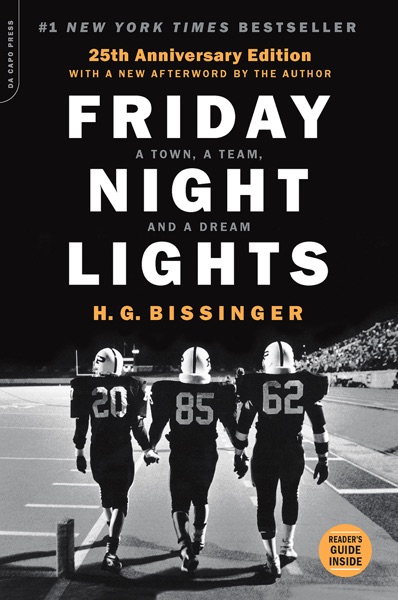
Talk to Friday Night Lights: A Town, a Team, and a Dream like its author wrote you back.
Get the ideas that fit your life — not generic summaries.
- Chat with the book
- Audiobook-style main ideas
- Adapts to your life and goals
- Helps you take action
What it argues
Friday Night Lights is H. G. Bissinger's account of the 1988 season of the Permian Panthers, a high school football team in Odessa, Texas, that he embedded with for a year. What he found was more complicated and more troubling than a sports story. Odessa had organized its entire civic identity around the performance of seventeen-year-old boys on a Friday night, and the town's racial and economic dynamics were inseparable from that obsession.
Bissinger follows the players closely — particularly Boobie Miles, a running back whose knee injury before the season begins sets in motion a personal story of rising and falling that becomes one of the book's most painful threads. He also follows the coaches, the boosters, the parents, and the school administrators who manage a program whose budget exceeds the academic department's by a significant margin. The imbalance is not incidental; it is the point.
What it gets right
- 1.
Odessa organized its collective identity around high school football to a degree that distorted educational priorities, racial dynamics, and the actual futures of the players.
- 2.
The Permian program spent significantly more on football than on academic programs — a disparity Bissinger documents in specific budget figures.
- 3.
Black athletes were celebrated on the field and largely invisible everywhere else in Odessa's civic life.
What it covers
Who wrote it
H. G. Bissinger is an American journalist and author who won the Pulitzer Prize for Investigative Reporting in 1987 as part of the Philadelphia Inquirer's reporting team. He moved his family to Odessa, Texas, for the 1988 season to report Friday Night Lights, which was published in 1990 and became one of the most influential works of narrative sports journalism. It was adapted as a film in 2004 and a television series from 2006 to 2011. Bissinger has also written A Prayer for the City, Three Nights in August, and Father's Day.
